
A software development company Bangalore businesses hire should solve a clear operating problem. The need may be a customer portal, an approval system, a CRM extension, a reporting dashboard, or one application that replaces several disconnected spreadsheets. The project becomes easier to judge when the business first defines who will use the system, what decision it must support, which data it needs, and what a successful release should change.
WebEscalate can plan and build business systems as part of a wider digital programme. The final architecture, technology stack, estimate, and delivery sequence should follow discovery rather than a preset package. This guide explains what to settle before approving a proposal and how to keep the build useful after launch.
What a software development company Bangalore businesses can expect
The work should start with the business process, not a feature list. A capable team maps the people involved, the steps they follow today, the handoffs that cause delay, and the information needed at each point. That gives the project a working boundary and helps separate the first release from ideas that can wait.
A software development company Bangalore project may include:
- Internal dashboards for operations, sales, finance, or service teams.
- Customer, vendor, employee, or partner portals.
- Approval, booking, inventory, document, and reporting workflows.
- CRM or ERP extensions that fill a specific process gap.
- API integrations between existing business tools.
- A SaaS or mobile product tested through a focused first release.
These are examples of possible system types, not a claim that every business needs custom software. A configured product can be the better choice when it covers the process well, offers suitable access controls, and costs less to own.
Decide whether custom software is the right answer
Custom development makes sense when an important workflow is unusual, existing tools create repeated manual work, or the business needs control over integrations and product direction. It can also help when several teams rely on different records and no one can see a dependable version of the same information.
Before commissioning a build, compare three options: improve the current process, configure an established platform, or create a custom system. Record the licence cost, implementation effort, missing capabilities, data ownership, integration limits, and expected maintenance for each option. This short comparison can prevent an expensive build whose main features already exist elsewhere.
A software development company Bangalore buyers shortlist should be willing to explain when configuration is enough. That advice keeps the project focused on gaps that standard software cannot handle well.
The decision should come from the workflow and risk. If a standard CRM handles most of the requirement, a targeted integration or extension may be enough. If the business model itself depends on a distinct product flow, custom application development offers more control.
Turn the workflow into testable requirements
Requirements are useful when a reviewer can tell whether the system satisfies them. “Create a user-friendly dashboard” is open to interpretation. “Allow an operations manager to filter open orders by status, location, and owner, then export the current view” gives the team something it can design and test.
Discovery should identify:
- User roles, permissions, and approval limits.
- Current steps, exceptions, duplicate work, and failure points.
- Source systems, records, required fields, and data quality issues.
- Integrations, authentication methods, and third-party limits.
- Reports, alerts, audit history, and retention needs.
- Launch criteria and the business measures used after release.
WebEscalate’s workflow automation service can help frame repetitive steps and handoffs before development begins. When the workflow is visible, the team can decide which parts need software, which need a policy change, and which should stay under human review.
Select the technology stack after discovery
The best-known framework is not automatically the best fit. Traffic, data sensitivity, integration requirements, team skills, hosting constraints, offline behaviour, and long-term ownership all affect the choice. A proposal should name the frontend, backend, database, infrastructure, authentication method, and major third-party services, then explain why each fits the requirement.
Ask how the architecture will handle growth, backups, access control, deployment, monitoring, and dependency updates. Also ask what happens if a chosen service changes its price or API. The answer should identify important dependencies and a practical route for replacement where the risk justifies it.
NIST’s Secure Software Development Framework recommends integrating secure practices into whichever software development life cycle an organisation uses. That makes security part of planning, implementation, verification, and response instead of a single review at the end.
Use staged delivery with visible acceptance checks
A software development company Bangalore engagement should show progress through working increments. A common sequence is discovery, prototype, system design, development, verification, data preparation, launch, and support. Some activities overlap, but each stage needs a clear output and reviewer.
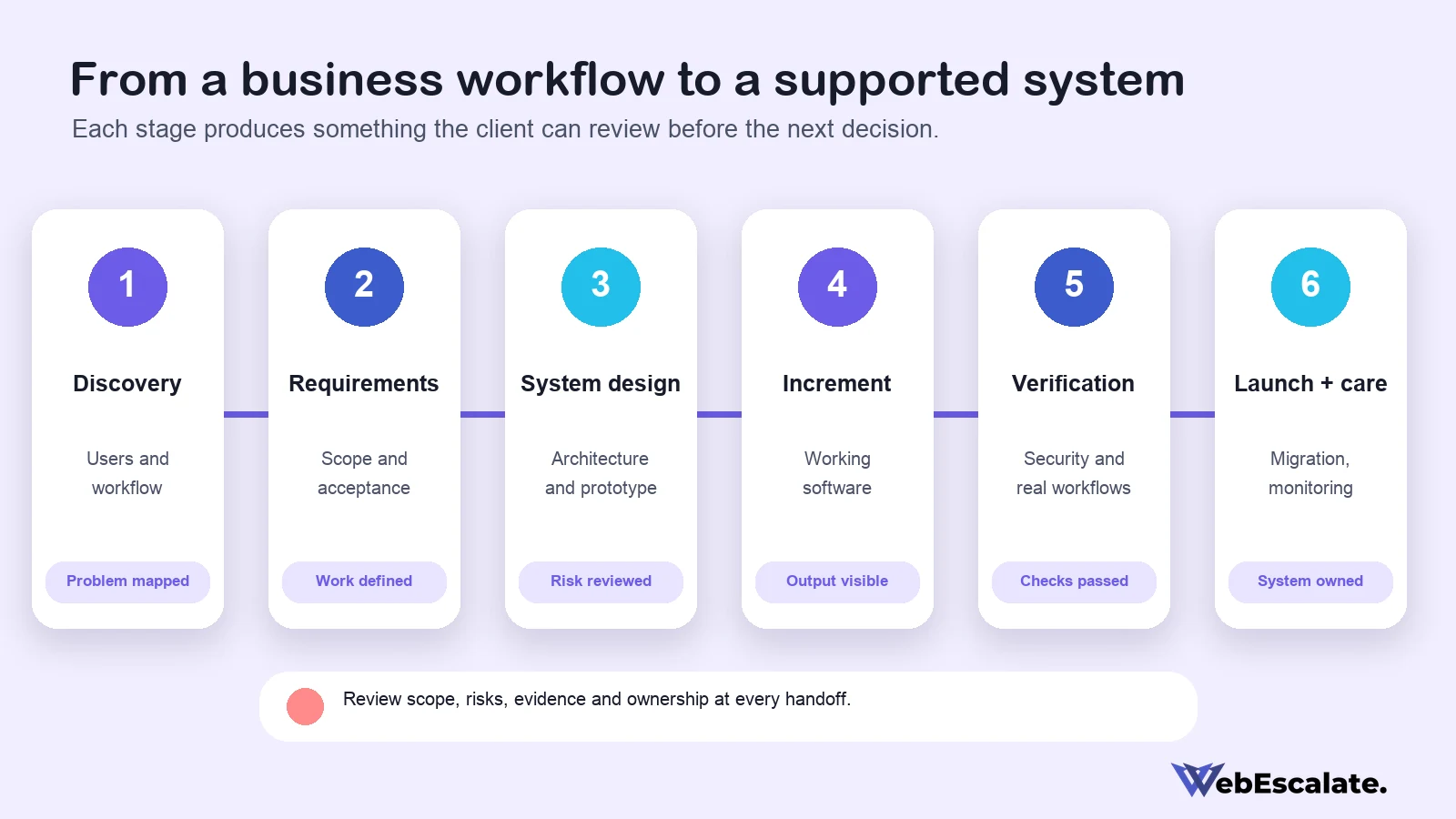
The first increment should prove the riskiest assumption rather than reproduce every screen in the final product. That risk may involve a complex integration, a permissions model, a high-volume import, or a user journey that still needs validation. Early evidence gives the business a chance to change direction before the cost rises.
At the end of each increment, review the agreed acceptance checks, open defects, decisions, and effects on scope. Keep a written record of changes. This gives both teams a shared view of what has been accepted and what still needs work.
The software development company Bangalore proposal should also name the client reviewer for each stage. Decisions move faster when the right person sees the working output and records approval or requested changes.
Build security and access control into the system
Security requirements depend on the data and actions in the application. The project should define user roles, least-privilege access, authentication, session behaviour, audit records, encryption needs, backup controls, and the response to suspected misuse. Administrative access deserves its own review because it can affect many records at once.
The OWASP Application Security Verification Standard provides a structured set of requirements for designing, developing, and testing web applications and web services. It can help the client and development team agree on relevant verification needs instead of relying on a vague promise that an application is secure.
Third-party libraries and services also need attention. The team should track important dependencies, restrict secrets to appropriate server-side storage, and define how updates are assessed. Security testing should reflect the system’s real risks and continue as the application changes.
Test accessibility, reliability, and real workflows
Testing should cover more than the expected path. Check empty states, invalid values, partial records, conflicting changes, slow integrations, permission boundaries, and recovery from failed actions. Include representative users because a technically correct screen can still make the business process harder.
WCAG 2.2 is a W3C Recommendation for making web content more accessible. Relevant criteria should be included in design and acceptance checks, especially for systems used by customers, employees, or the public. Keyboard access, labels, focus order, contrast, error identification, and responsive behaviour are practical starting points.
AWS Well-Architected reliability guidance recommends testing functional behaviour, scaling, performance, resilience, and operational playbooks. The exact test plan will vary, but the principle is useful: reliability has to be verified under conditions the system may actually face.
Plan integrations and data migration carefully
Integrations often control the real project risk. List the systems involved, data owner, direction of transfer, expected frequency, field mapping, authentication method, rate limits, and failure behaviour. Decide which system is authoritative when records disagree.
Migration needs the same care. Inspect sample data early, identify duplicates and missing fields, and agree on transformation rules. Run a trial migration before launch and reconcile record counts and important totals. Keep the rollback and cutover plan simple enough for the team to follow under pressure.
When the website is part of the customer journey, the Bangalore web development guide explains how service pages and conversion paths can support local buyers. The application and marketing site should share clear handoffs without exposing private operational data.
Include monitoring, support, and ownership in the proposal
Launch changes the work rather than ending it. The team needs logs, alerts, health checks, backup verification, and a process for investigating incidents. Microsoft’s monitoring design guidance treats telemetry as part of the architecture and encourages teams to design it alongside the workload.
The support agreement should explain what is monitored, who receives alerts, how issues are prioritised, and which changes fall outside routine maintenance. It should also identify the release process and the environments used for development, testing, and production.
Ask the software development company Bangalore team to show how an alert becomes an investigation, a fix, and a documented release. This makes the support process easier to assess before the system is live.
Confirm ownership before work starts. The agreement should cover source code, design files, cloud accounts, domains, data, documentation, and third-party subscriptions. The client should receive the access and handover material promised in the contract.
How to evaluate a software development company in Bangalore
Ask each provider to explain the business problem in its own words before reviewing the proposed solution. A useful response should show the users, workflows, dependencies, risks, first release, and acceptance process. A long feature list without these connections is harder to evaluate.
Use this checklist during comparison:
- Does the proposal state the problem, users, scope, exclusions, and assumptions?
- Does it explain the stack and major architectural choices?
- Are integrations, migration, security, accessibility, and testing included?
- Can the team show evidence it has permission to share?
- Are milestones linked to reviewable outputs and acceptance checks?
- Does the estimate separate build work, infrastructure, licences, and ongoing support?
- Are ownership, access, handover, maintenance, and exit terms clear?
WebEscalate’s broader digital and development services can connect the system with the website, automation, SEO, and other customer-facing work when those areas belong in the same plan.
Frequently asked questions
What does a software development company do?
It studies a business or product problem, designs a technical solution, develops and tests the software, supports deployment, and maintains the system under an agreed scope. The work may include web applications, mobile products, portals, dashboards, integrations, or extensions to existing platforms.
How does a custom software development project work?
The process usually begins with discovery and requirements, followed by design, architecture, incremental development, verification, migration, launch, and support. The exact sequence depends on risk and scope. Each stage should have a named reviewer and an output the client can inspect.
How much does custom software development cost in Bangalore?
Cost depends on the users, workflows, interfaces, integrations, data migration, security needs, platforms, testing, and support. A credible estimate needs enough discovery to show assumptions and exclusions. Ask for infrastructure, licences, third-party services, maintenance, and taxes to be separated from build fees.
When is custom software worth the investment?
It may be worthwhile when an important process creates recurring delay or error, standard products leave a costly gap, or the business needs a distinct digital product. Compare custom development with process improvement and configured software before choosing. The expected operational value should justify the continuing cost of ownership.
What should a business prepare before requesting a proposal?
Prepare the problem, user roles, current workflow, example records, required integrations, known constraints, decision makers, and desired launch outcome. Include any data, security, accessibility, or compliance needs. This information helps the provider identify uncertainty and propose a sensible first release.
Plan the first useful release
A software development company Bangalore businesses can trust should make scope, trade-offs, evidence, and ownership visible. Begin with the workflow, choose the first release around the largest risk, and require acceptance checks for every increment. The result should be a system the team can operate and improve, not only a set of screens.
Contact WebEscalate to discuss the workflow, users, integrations, constraints, and evidence needed for a business-system proposal.