A B2B digital marketing agency in Domlur Bangalore should help a technology-service company attract the right accounts, explain a complex offer, and show which enquiries turn into qualified sales conversations. More traffic alone does not solve a weak pipeline. The work starts with a precise market, useful evidence, and a handoff that lets sales return lead-quality information to marketing.
Domlur-based teams can sell across Bengaluru, India, or international markets. The location gives the page local relevance, but the campaign still needs to reflect the industries, company sizes, roles, and problems the business can genuinely serve. This guide explains how to build that system without claiming a local office, guaranteed leads, or results that have not been verified.
What a B2B digital marketing agency in Domlur Bangalore should clarify first
Start with the buying situation, not a list of channels. A software consultancy seeking product-development projects needs a different plan from an IT support provider selling annual contracts. Record the service, typical buyer, useful company characteristics, buying trigger, common objection, and the action a serious prospect should take. This becomes the working market definition for search, paid media, content, and sales follow-up.
B2B decisions often involve several people. LinkedIn’s overview of B2B marketing describes roles such as finance, IT, and procurement as part of the buying process. A campaign therefore needs material for more than one reader. A technical evaluator may need architecture and integration details, while a department head may need delivery scope, risk controls, and the business reason for acting now.
A useful brief should answer these questions:
- Which service and project type is the campaign promoting?
- Which companies can WebEscalate serve well, and which are outside the scope?
- Who researches the problem, who evaluates the solution, and who approves the spend?
- What evidence can be published with permission?
- What information must a prospect provide before the enquiry is useful to sales?
This brief prevents a common failure: broad campaigns that attract students, job seekers, vendors, and small requests that do not match the service. It also gives the agency and sales team one definition of a qualified opportunity.
Build search demand around a specific technology-service problem
Commercial searches often describe a provider category, but early research searches describe a problem. A prospect might look for a B2B marketing agency, then investigate demand generation, CRM attribution, software lead generation, or website conversion. The content plan should connect those stages without creating several pages that compete for the same keyword.
The broad digital marketing agency in Bangalore page should remain the main city-level service page. A Domlur article needs a narrower job. Here, the focus is marketing for technology-service firms that have long evaluation cycles, several decision makers, and a need to connect campaigns with sales qualification. Supporting articles can address a distinct question, such as CRM lead tracking or technical case-study structure, and link back to the relevant service page.
Search-result research should also shape the page. Review the type of pages Google currently ranks, the questions in People Also Ask, and the language used in related searches. Use that information to cover the reader’s decision, not to copy a competitor’s headings. Exact locality searches may show little recorded volume, so the page should also answer the broader B2B marketing need while keeping the location and service clear.
Turn the website into a usable B2B evaluation path
A technology-service website should let a prospect understand the offer before requesting a call. Give each important service its own page and explain the problem it solves, the work included, required inputs, delivery boundaries, and next step. The website development service can support this structure when the current site cannot separate services or track useful enquiries.
Evidence should sit beside the claim it supports. A case study needs the client’s permission, a defined starting point, the work completed, and a result that can be checked. When that evidence is unavailable, use process detail instead of a generic success statement. Show how discovery works, what gets reviewed, who approves changes, and how risks are handled. That is more credible than calling the team the best agency in an area.
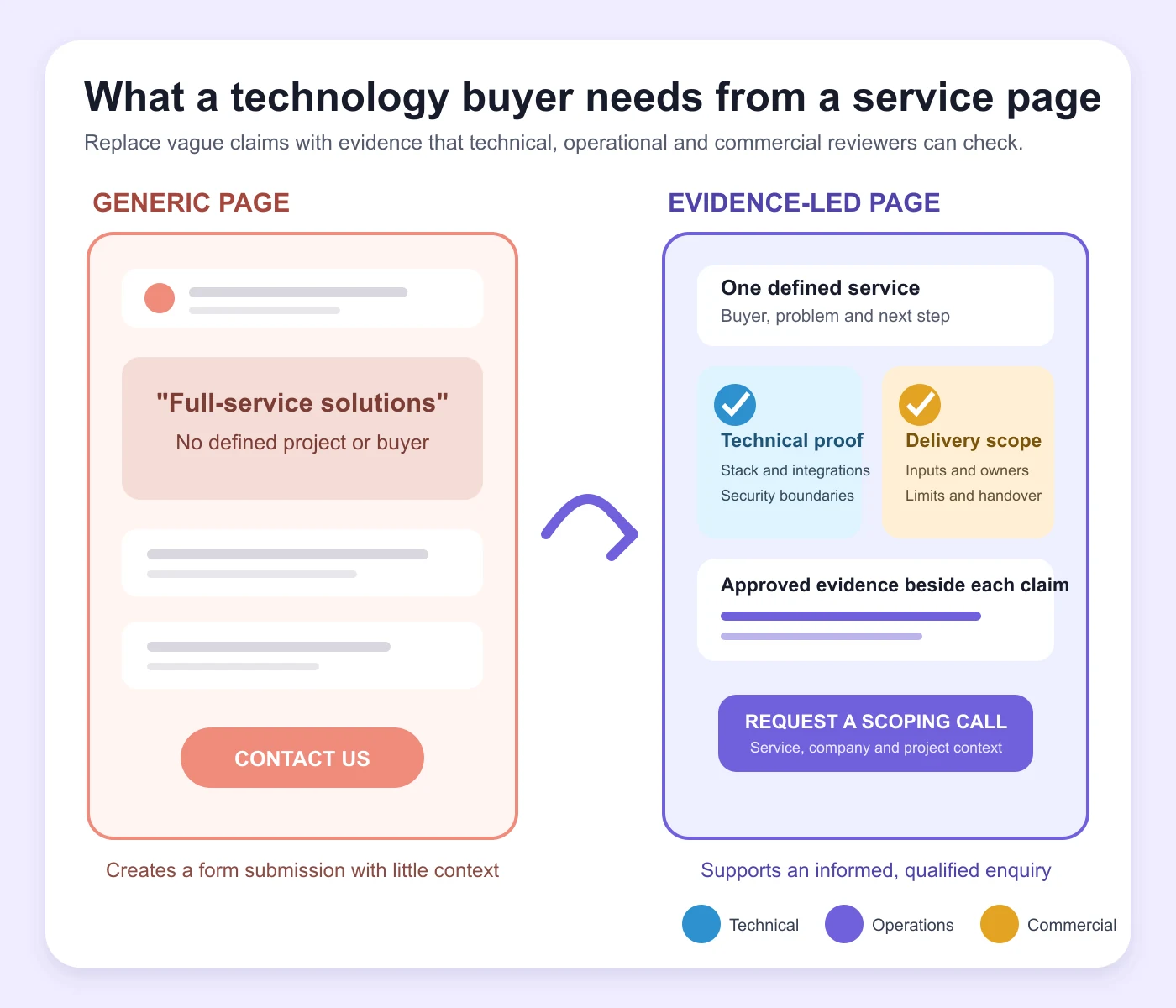
The enquiry form should collect only information the sales team will use. Service interest, company name, project context, timing, and a preferred contact method are often more useful than a long list of mandatory fields. Publish a clear privacy notice and decide where the data goes before the form launches. The team should also test confirmation messages, notification delivery, CRM assignment, and mobile usability.
Use channels according to the buyer’s stage
Search, LinkedIn, email, and retargeting can support different parts of the decision. Search captures an active question. LinkedIn can reach professional roles and companies. Email can continue a conversation after a person has chosen to hear from the business. Retargeting can bring a visitor back to a relevant service page or case study. Running every channel with the same message wastes the context that made each visit possible.
LinkedIn’s guide to B2B lead generation recommends defining how a lead will be assessed, using factors such as company fit or the action taken. Its explanation of demand generation and lead generation also separates creating interest from capturing contact details. That distinction is useful for technology services. Educational pages can build familiarity, while project checklists, audits, and consultation pages can serve prospects who are closer to contacting a provider.
Every campaign should define one next action and the page that supports it. An ad about application modernization should not send visitors to a generic home page. It should lead to a page that explains modernization scope, integrations, migration risk, and the information needed for an initial assessment. Campaign naming and UTM parameters should be agreed before launch so the source remains readable in analytics and the CRM.
Connect lead capture with qualification and sales feedback
Form submissions are the beginning of measurement. Google Analytics recommends a set of lead-generation events for online and offline activity: generate_lead, qualify_lead, disqualify_lead, working_lead, close_convert_lead, and close_unconvert_lead. The related Lead acquisition report can then show which channels bring new, qualified, and converted leads when the events are implemented correctly.
The CRM should store the original source, landing page, service interest, qualification status, owner, and reason an opportunity was won or lost. Agree on the meaning of each status before automating updates. A form submission should not be reported as a qualified lead until the team has applied its qualification rules. This keeps marketing reports useful when two channels produce the same number of forms but very different sales outcomes.
For advertisers who import offline outcomes, Google’s guidance on enhanced conversions for leads explains how hashed user-provided data and offline conversion data can improve matching. Any implementation must follow the company’s consent, privacy, retention, and access requirements. Tracking should be designed with the person responsible for analytics, the CRM owner, and whoever approves data handling.
WebEscalate’s workflow automation service can support lead routing and system handoffs when a project requires integration work. The scope should still document field ownership, failure alerts, duplicate handling, manual review, and what happens when an external service is unavailable.
Review an agency on operating evidence, not a channel list
Most agencies can name the same channels. The useful difference is how they make decisions and show their work. Ask for the market definition, keyword and content map, landing-page plan, tracking specification, reporting structure, and the process for recording sales feedback. A proposal should also state which tasks need access to advertising, analytics, website, and CRM systems.
For a technology-service company, the review should cover:
- how technical claims will be checked before publication;
- how confidential project details and client names will be protected;
- which conversion and qualification stages will be measured;
- how duplicated, spam, and poor-fit enquiries will be handled;
- how content, media, landing pages, and CRM records will be handed over.
Do not accept a forecast as a guarantee. Ask which assumptions sit behind projected traffic, leads, or pipeline and how performance will be reviewed when reality differs. A practical plan sets a review cadence, records changes, and protects enough time to learn from qualified outcomes rather than reacting to every click.
Plan the first working session
Bring the current service list, target industries, a sample of recent enquiries, approved proof, website access details, analytics setup, and the CRM stages used by sales. The first session should end with a defined audience, one priority offer, a conversion path, measurement requirements, and a short list of missing evidence. It does not need to produce a large channel calendar immediately.
WebEscalate can review the website, search demand, campaign path, and lead handoff for a Domlur-based technology-service company without presenting an unverified local branch or local client claim. Use the contact page to share the service, target customer, current lead sources, and the system used to manage enquiries.
Frequently asked questions
What does a B2B digital marketing agency do?
A B2B agency helps a company define the accounts and roles it wants to reach, create useful sales and marketing material, run appropriate channels, improve landing pages, and measure enquiries through qualification. The exact work should depend on the service, sales process, available evidence, and systems already in use.
How does digital marketing work for a B2B company?
Digital marketing helps potential buyers find and evaluate a provider before contacting sales. Search pages answer active questions, content explains the problem, campaigns distribute relevant material, and the website gives each stakeholder enough evidence to take the next step. Analytics and CRM stages then show which sources produce qualified opportunities.
How should a technology company choose a B2B marketing agency?
Review the agency’s research method, technical fact-checking, content approval process, conversion tracking, CRM handoff, and reporting. Ask how it separates form submissions from qualified leads. Any case study or result used in the decision should have a clear source and relevant context.
How much do B2B digital marketing services cost?
Cost depends on the channels, content volume, landing-page work, media budget, analytics setup, CRM integration, and reporting needed. Request a scope that separates one-time setup, ongoing work, advertising spend, software fees, and optional development. That makes proposals easier to compare without relying on an unsupported package price.