A software development company in Electronic City Bangalore should help a buyer define the operating problem before discussing frameworks or screens. The project may involve an internal portal, an ERP or CRM extension, a reporting tool, a customer application, or an integration between systems that hold different parts of the same record.
Electronic City is an industrial and technology township with companies working across software services, electronics, manufacturing, health technology and other sectors. The Electronics City Industrial Township Authority manages the township, while ELCIA represents a broad member base. That mix creates many possible software needs, but an area name does not tell a developer what to build. A useful proposal starts with the workflow, users, records, integrations and risks.
This guide explains how to prepare that brief, decide whether to configure or build, and compare proposals without relying on vague promises.
What a software development company in Electronic City Bangalore should clarify first
Begin with one business process that has an owner and a visible problem. Examples include approving purchase requests, tracking field service work, reconciling inventory, onboarding vendors, preparing compliance records, or giving customers a reliable status view. Write down where the process begins, who touches it, which system holds each record, and where work gets delayed or repeated.
A discovery discussion should answer practical questions:
- Which people use the process, and what may each role view or change?
- Which record is authoritative when two systems disagree?
- What exceptions need human approval?
- Which integrations are required for the first release?
- What evidence will show that the release works?
WebEscalate’s workflow automation service can help map repetitive steps and approval points. The broader software development company in Bangalore guide covers city-wide architecture, testing and provider evaluation. This Electronic City article concentrates on defining the system boundary and procurement decision for an operational tool.
Decide whether to configure, integrate or build
Custom development carries ongoing ownership. The business must maintain the application, hosting, dependencies, integrations, user access and support process. Compare that obligation with the limits of an established product before approving a build.
Start with packaged software when it covers the core workflow and its configuration model can handle the real user roles and exceptions. Consider an integration or extension when the current ERP, CRM or service platform works but information has to move between tools. A custom system becomes more reasonable when the workflow is materially different, the business needs control over the product direction, or standard tools force staff to maintain a parallel process outside the system.
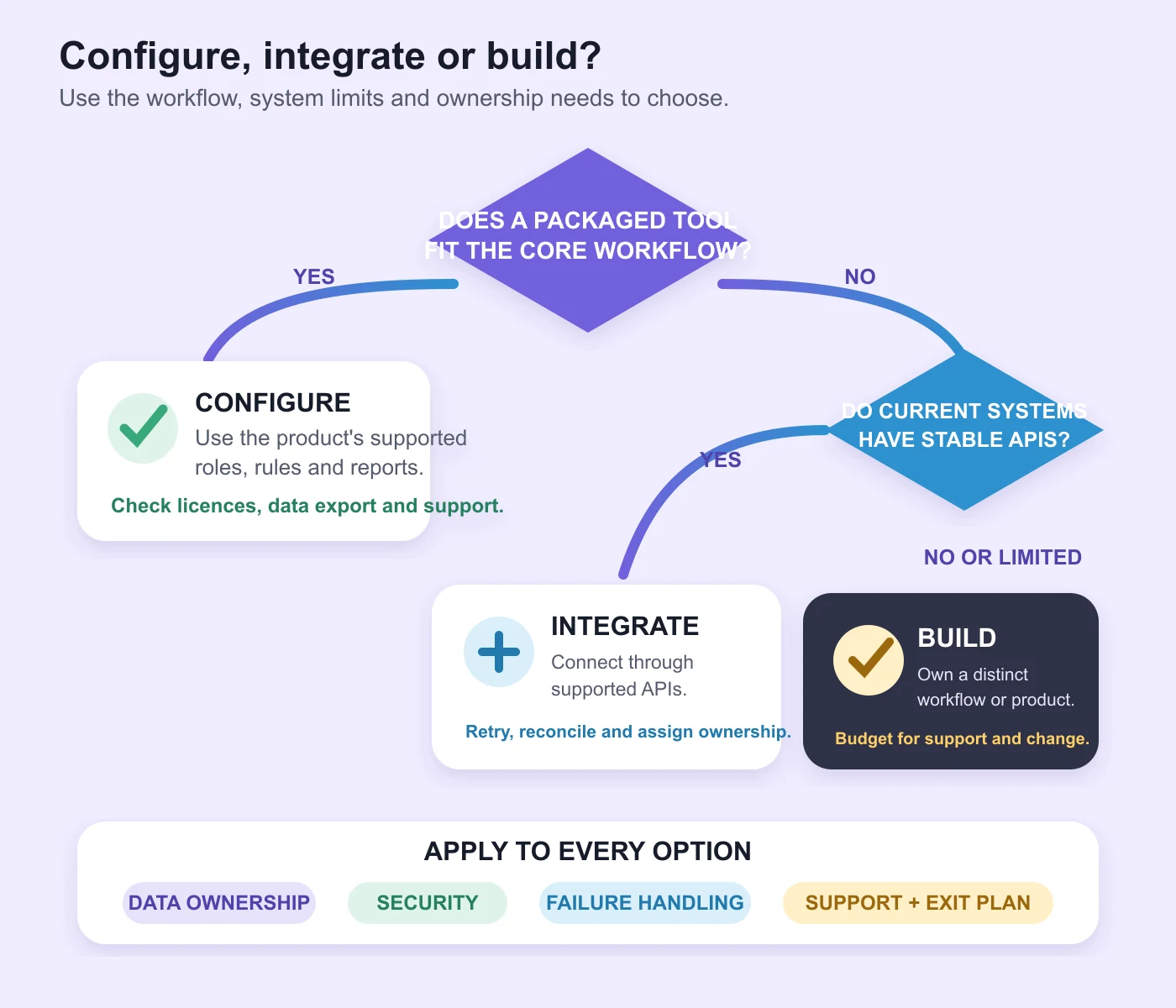
Record the decision in plain language. State which option was considered, what it covers, which gaps remain, and who accepts the continuing cost. This creates a useful reference if the scope changes later.
Draw the system boundary before choosing a technology stack
The system boundary shows what the application owns and what remains in another platform. List every system involved, the data exchanged, the direction of transfer, the expected frequency and the response when a transfer fails. Mark the source of truth for customers, products, orders, payments, documents and user identities that matter to the project.
This exercise prevents a common planning error: treating an integration as a small connector when it controls permissions, duplicate handling, retries and audit records. Ask the provider to document each external dependency and its limits. If an API changes, a vendor account is suspended, or a request times out, the application needs a defined response.
The NIST Secure Software Development Framework includes practices for documenting security requirements, risks and design decisions. These records belong in discovery and architecture work because they affect the shape of the system throughout the project.
Choose the stack after these constraints are visible. A proposal should explain the frontend, backend, database, infrastructure, identity approach and major services. It should also say why each choice fits the users, data, integrations, support model and expected ownership.
Write requirements that can be tested
A phrase such as “build a simple dashboard” leaves too much room for interpretation. A testable requirement names the user, action, data and expected result. For example: “An operations manager can filter open service requests by location, owner and due date, then export the filtered list.”
Requirements should cover ordinary work and exceptions. Include invalid values, incomplete records, duplicate submissions, expired sessions, unavailable integrations and conflicting updates. Define the expected message and recovery path for each important failure. If staff must correct a record, say who can do it and what audit history remains.
Keep the first release small enough to verify. A focused release can prove the hardest integration, permission model or workflow before the team adds every report and convenience feature. Link milestones to working outputs and written acceptance checks instead of percentages such as “development 80% complete.”
Set security acceptance criteria before development
Security depends on the data, actions and users in the application. Define authentication, role permissions, administrative access, session behaviour, audit records, encryption needs, backup expectations and incident responsibilities. Sensitive exports and bulk actions need their own controls because one action can expose or change many records.
The OWASP Application Security Verification Standard provides requirements for designing, developing and testing web applications and services. It gives buyers and developers a shared reference for agreeing on relevant controls. For APIs, the OWASP API Security Project covers risks such as authorization failures, unrestricted resource use and unsafe consumption of third-party APIs.
Ask how the team protects source code, secrets, deployment credentials and software components. The agreement should name the environments used for development, testing and production, along with the access each party receives. Security responsibilities continue after launch through dependency updates, access reviews, logging and incident handling.
Test the complete workflow and individual screens
Component tests and automated checks help, but the buyer also needs end-to-end scenarios based on real work. Run representative records through the complete path. Include a standard case, an exception that needs approval, a failed integration, a permission boundary and a recovery step. Reconcile important totals when data moves between systems.
Accessibility also belongs in acceptance criteria. WCAG 2.2 is the W3C Recommendation for accessible web content. Relevant checks may include keyboard operation, visible focus, labels, error identification, contrast, target size and responsive behaviour. The exact scope depends on the users and interface, but it should be written before final testing.
Performance tests need a stated workload. Ask which pages, imports, reports or API operations are time-sensitive and how many concurrent users the test represents. Avoid a blanket claim that the software is “fast” without a method, environment and threshold.
Plan monitoring, support and change ownership
A business system needs enough telemetry to show when an important action fails. Logs should identify the event without exposing sensitive data. Alerts need an owner and an escalation route. Microsoft’s monitoring design guidance recommends planning telemetry alongside the workload so teams can understand health and investigate problems.
The support agreement should separate defects, routine maintenance and new scope. It should identify supported hours, contact routes, severity definitions, environments, backups, update responsibilities and excluded third-party failures. WebEscalate should only commit to a response time or service level after those terms are agreed in writing; this article does not promise one.
Changes also need a simple process. Record the request, effect on scope, security or data implications, estimate, decision and release. This prevents a growing collection of informal changes from obscuring the original acceptance criteria.
Require practical ownership and handover
The contract should state who owns the source code, designs, database, cloud account, domains, credentials and documentation. It should list third-party services and licences separately because ownership of the custom code does not transfer a vendor’s subscription or intellectual property.
A useful handover package may include:
- Repository access and a tagged release that matches production.
- Architecture, data-model and integration documentation.
- Environment setup, deployment and rollback instructions.
- Administrative guidance and user documentation where required.
- Known limitations, open defects and support contacts.
Confirm these items before the last milestone. A handover that begins after the final invoice often exposes missing access or undocumented dependencies when the project has little time left.
How to compare Electronic City software development proposals
Give each provider the same brief and ask for the assumptions behind its recommendation. Compare proposals on the problem definition, scope boundary, architecture, integration plan, security criteria, testing, handover and support. A lower build estimate may exclude migration, infrastructure, licences or post-launch work.
Use these questions during the review:
- Which part of the workflow belongs in the first release, and why?
- Which existing products or extensions were considered?
- What are the main technical and delivery risks?
- How will integrations retry, reconcile and report failures?
- Which security and accessibility checks are acceptance criteria?
- What access, documentation and accounts will the client receive?
- What remains outside the estimate?
For a customer-facing application or portal, WebEscalate’s website development services can connect the product experience with public pages and enquiry paths. The scope should still keep marketing content separate from private operational data.
Frequently asked questions
What does a software development company do?
It studies a business or product problem, defines requirements, designs the system, develops and tests the software, supports deployment, and maintains it under an agreed scope. The work may include internal tools, customer portals, mobile applications, integrations, ERP or CRM extensions, and SaaS products.
Should a business buy software or build a custom system?
Buy or configure an established product when it covers the core workflow and its limits are acceptable. Integrate or extend a current platform when the main gap is data movement or a focused capability. Consider a custom build when the workflow is materially different, the product itself creates business value, or standard tools require costly workarounds.
How much does custom software development cost in Bangalore?
Cost depends on users, workflows, interfaces, integrations, data migration, security, platforms, testing and support. A useful estimate shows assumptions and exclusions, then separates build work from infrastructure, licences, third-party services, taxes and maintenance. This article does not provide a price range because no fixed scope has been defined.
How long does a business software project take?
The schedule depends on scope, decision speed, integration access, data quality, security review and acceptance testing. Ask for milestones linked to working outputs and named reviewers. A discovery phase should reduce uncertainty before the provider commits to a detailed delivery plan.
Can a new system integrate with an existing ERP or CRM?
Often, if the platform provides suitable APIs or supported extension points. The team must confirm authentication, data ownership, rate limits, field mapping, error handling and reconciliation. If an integration depends on unsupported database access or manual exports, that limitation should appear in the proposal.
Prepare a brief for the first useful release
A software development company in Electronic City Bangalore can prepare a credible proposal when the brief names the users, workflow, records, integrations, risks and acceptance checks. Compare configuration, integration and custom development before selecting the approach. Then require visible boundaries for security, ownership, support and change.
Contact WebEscalate to discuss the process, user roles, systems and constraints that belong in an Electronic City business-system brief.