Local SEO services in Marathahalli Bangalore should begin with a simple eligibility check: where does the business actually operate, and how do customers receive the service? A clinic with a staffed location, a repair company that visits customers, and a consultant serving clients remotely need different Google Business Profile settings and website paths.
This guide is for service-area businesses that want enquiries from Marathahalli and nearby parts of east Bengaluru. It covers Business Profile rules, service areas, local pages, reviews, structured data, and enquiry measurement. It does not claim that WebEscalate has an office in Marathahalli, promise a Maps position, or present local results that have not been verified.
What Local SEO Services in Marathahalli Bangalore Should Check First
Start with the business model rather than a keyword list. Record the legal business name, public-facing name, staffed customer locations, service areas, opening hours, phone numbers, primary services, and the person responsible for enquiries. Compare that record with the website, Business Profile, directories, invoices, and real-world signage.
Google’s Business Profile representation guidelines require accurate real-world information. They also say a business should use the fewest categories needed to describe its core activity and generally keep one profile per business. Adding Marathahalli to a business name, address, or profile when it is not part of the real operation creates a policy risk rather than a local SEO advantage.
The first audit should end with an eligibility decision. A customer-facing location may show its address when it is staffed and eligible. A business that visits or delivers to customers without receiving them at its address should use a service-area profile and hide the address. A remote-only company may not qualify for a profile unless its operation meets Google’s requirements.
Define the Actual Service Area Around Marathahalli
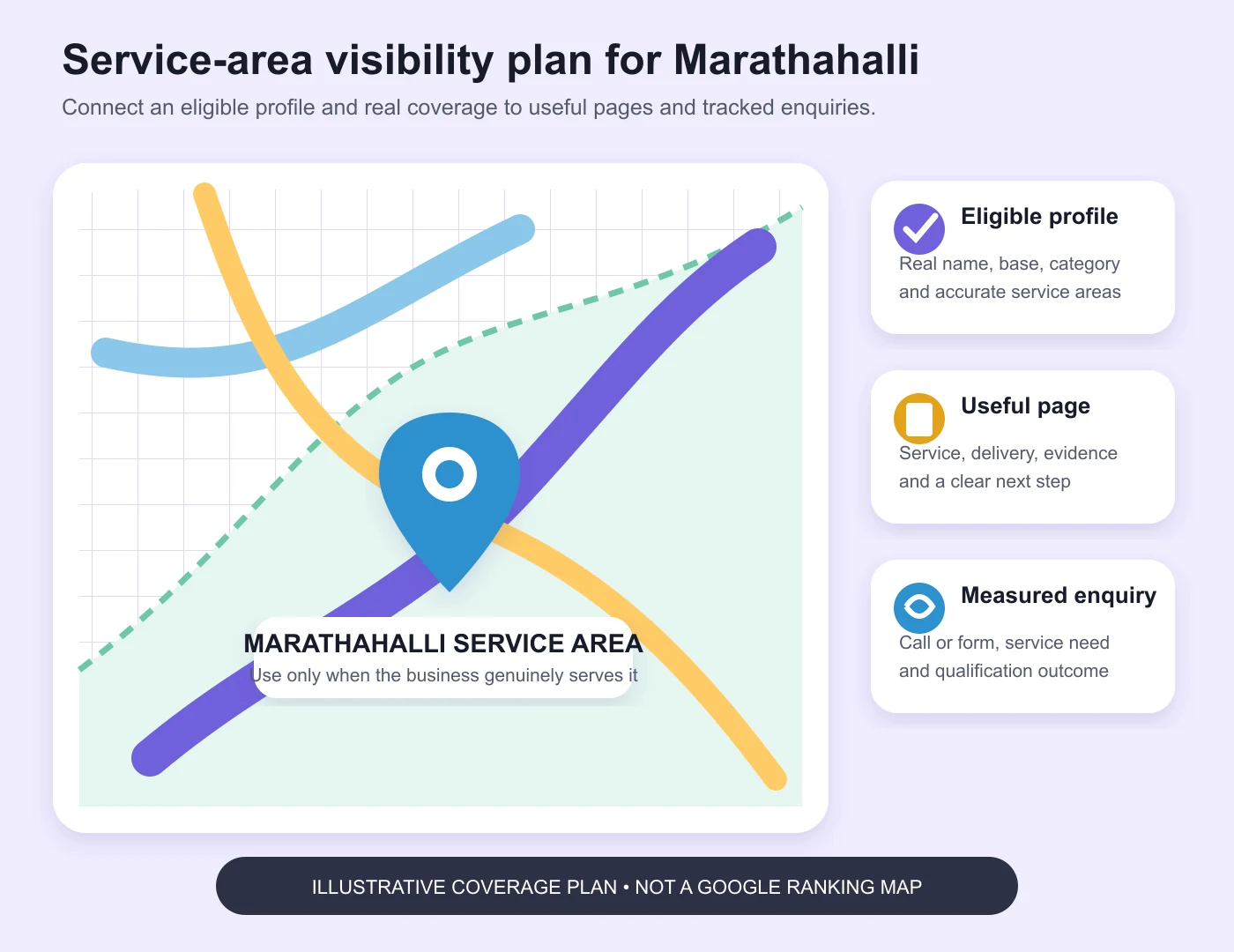
A service-area plan should match the places the team can serve consistently. Write down the services available in each area, travel or delivery limits, normal response process, and any location-specific exclusions. This prevents the marketing page from promising a visit or delivery the operations team cannot provide.
Google’s service-area guidance allows eligible businesses to select up to 20 service areas using cities, postal codes, or other supported areas. It says the overall boundary should generally remain within about two hours of driving time from the business base. Google no longer uses an editable radius for this setting.
The selected service area does not guarantee a ranking in every included place. Google’s local ranking guidance explains that local results mainly depend on relevance, distance, and prominence. Distance changes with the searcher’s location, so the same business can appear differently across Marathahalli, another Bengaluru locality, and a wider city search.
Build an Accurate Google Business Profile
The profile should help a customer understand whether the business fits the need. Use the real business name, an accurate primary category, supported secondary categories, current hours, a monitored phone number, and the correct website or appointment page. Add services that the business genuinely provides and keep descriptions factual.
Photos should show the operation customers will encounter: the premises when customers visit, the team where permission exists, equipment, completed work, or the delivery process. Avoid stock images that make a virtual operation look like a Marathahalli storefront. WebEscalate’s Google Map optimisation service covers profile setup and ongoing map visibility work within the business’s actual operating model.
Assign profile access to named owners and managers. Keep recovery details current, record major edits, and review public changes that Google or users may suggest. A profile can become inaccurate after a phone, hours, category, or address change even when the original setup was correct.
Give Each Priority Service a Useful Website Path
A local page needs more than a place name. It should explain the service, who it suits, the work included, evidence the business can publish, the service area, the next step, and the limitations a buyer should know before contacting the company. Replacing the locality in a repeated template leaves little information that is specific to the customer’s decision.
For a service-area business, explain how work is delivered around Marathahalli. A home-service company may describe booking, arrival windows, access requirements, and coverage. A professional service may describe remote or on-site meetings, documents needed, review stages, and who owns the decision. Only state a local office or local project when the business can prove it.
Link the page to the broader service description and to closely related resources. WebEscalate’s search engine optimisation service covers technical, on-page, content, and monitoring work. When a site needs a clearer local enquiry path, the website development service can support page structure, forms, and tracking.
Keep Business Details Consistent Where Customers Check Them
The name, phone number, address or service-area status, hours, and main website should agree across the sources the business controls. Review industry directories, social profiles, map listings, local associations, booking platforms, and old landing pages. Correct high-impact conflicts first, especially details that could send a customer to the wrong place or an inactive number.
Consistency does not mean copying a keyword-filled description to every directory. Each listing should follow the platform’s rules and use the real business identity. Maintain a simple source register with the listing URL, login owner, current details, last review date, and correction status.
Local mentions can support discovery when they come from real relationships or useful resources. Examples include a supplier page, an industry association, a local event partner, or a publication that has covered the business. Buying unrelated directory placements in bulk can create maintenance work without helping customers verify the company.
Request Reviews Without Incentives or Scripts
Ask customers for a review after a genuine service interaction. The request can use Google’s review link or QR code, but it should not offer a discount, gift, or other benefit. Google’s review guidance says reviews must reflect a genuine experience and prohibits incentives for posting, changing, or removing them.
Send every customer the same neutral request rather than selecting only people expected to leave a high rating. Do not provide a prepared review that inserts services or locations the customer did not mention. A useful internal process records when the request was sent and stops repeated reminders.
Reply with enough context to be useful while protecting privacy. Thank the customer, answer the point raised, and move account-specific details to a private channel. Reviews may help a buyer compare businesses, but a review count or rating does not guarantee a particular local position.
Use Structured Data That Matches the Visible Page
LocalBusiness structured data can describe a business to Google using fields such as its name, address, telephone, hours, URL, and business type. The markup should match visible information and the real operating model. A service-area business should not add a fabricated public address merely to complete a schema field.
Google’s LocalBusiness structured data documentation recommends adding the required properties, following the guidelines, testing the markup, and checking the live URL in Search Console. Valid markup makes a page eligible for supported search features; it does not guarantee that Google will display them.
Technical checks should also cover indexability, canonical tags, mobile layout, page speed, internal links, title and description quality, and form behaviour. Test the page after deployment rather than relying on a plugin’s green status alone.
Measure Enquiries Alongside Profile Views
Google Business Profile performance can report searches, views, calls, directions, website clicks, messages, and other interactions where they apply. Google’s performance documentation notes that only eligible metrics appear and that profile views are counted differently from some older reports.
Connect these interactions to the website and enquiry process. Use tagged website links where appropriate, record calls and forms with consent, and capture the service and location requested. The CRM should distinguish spam, wrong-service enquiries, unreachable contacts, qualified enquiries, booked work, and completed work.
Review the data by service and area. A rise in profile views with no change in appropriate enquiries calls for investigation. The issue could be an irrelevant query, a weak page, an incorrect phone number, a form problem, or slow follow-up. Do not infer revenue from views, calls, or direction requests without sales records.
What a Local SEO Engagement Should Include
A practical scope states what the provider will inspect, change, monitor, and report. It may include eligibility review, profile corrections, category and service setup, website pages, technical fixes, directory cleanup, review operations, local content, link research, reporting, and enquiry tracking. Ownership and approval rules should be written down before edits begin.
Ask how the agency handles profile access, sensitive data, rejected edits, suspensions, duplicate profiles, customer reviews, and content approval. Confirm which work is included in the fee and which items require development, photography, directory subscriptions, or advertising spend.
Ranking guarantees are a warning sign. Google states that businesses cannot request or pay Google for a better local ranking. A provider can improve accuracy, relevance, technical quality, evidence, and measurement, but distance and competition remain outside its control.
Seven Checks Before Local SEO Work Goes Live
- Confirm Business Profile eligibility and choose the correct storefront, service-area, or hybrid setup.
- Record the real business name, categories, phone, hours, website, and areas served.
- Map each priority service to a useful page with approved evidence and a clear enquiry path.
- Correct conflicting details on important directories and profiles.
- Set a policy-compliant review request and response process.
- Validate indexability, structured data, mobile layout, forms, and tracking.
- Connect profile and website interactions to qualified enquiry outcomes.
Keep the checks in one change log. Record the original state, approved edit, owner, date, verification method, and follow-up result. That history helps the team investigate a visibility or enquiry change without guessing which edit caused it.
Frequently Asked Questions
What are local SEO services?
Local SEO services improve the accuracy and usefulness of a business’s presence in location-based search. The work can include Business Profile management, service and location pages, technical SEO, directory corrections, reviews, local links, and enquiry measurement. The exact scope depends on profile eligibility and how the business serves customers.
How much do local SEO services cost?
Cost depends on the number of profiles, locations, services, website changes, directory problems, content requirements, tracking setup, and reporting work. Ask for a written scope that separates setup, monthly management, development, media, and third-party costs. No verified WebEscalate price was supplied for this article.
Are local SEO services worth it for a service-area business?
They may be useful when customers search by service and location and the business can serve those enquiries. Value depends on accurate profile eligibility, website quality, competition, follow-up, and the value of qualified work. Measure calls and forms through to suitable enquiries rather than judging the project only by views.
Can a service-area business rank in Marathahalli without an office there?
An eligible service-area business can specify areas it genuinely serves, but adding an area does not guarantee visibility there. Google considers relevance, distance, and prominence. The business should hide an address where it does not receive customers and should never create a virtual Marathahalli office for ranking purposes.
How long does local SEO take?
Timelines vary with profile verification, edit reviews, indexing, competition, website condition, and the amount of evidence available. Some profile edits may appear quickly, while website crawling, review growth, and broader visibility can take longer. A sensible plan sets review dates and reports completed work without promising a fixed ranking date.
Plan Local Visibility Around Real Service Coverage
Local SEO services in Marathahalli Bangalore work best when the profile, website, directories, reviews, and enquiry records describe the same business. The useful starting point is an eligibility and consistency audit, followed by changes the company can support with real operations and evidence.
To review a service-area setup, share the Business Profile link, website, services, staffed locations, areas served, current directory listings, and recent enquiry issues through the WebEscalate contact page. The audit should identify inaccurate information, policy risks, missing page paths, and measurement gaps before any visibility claim is made.