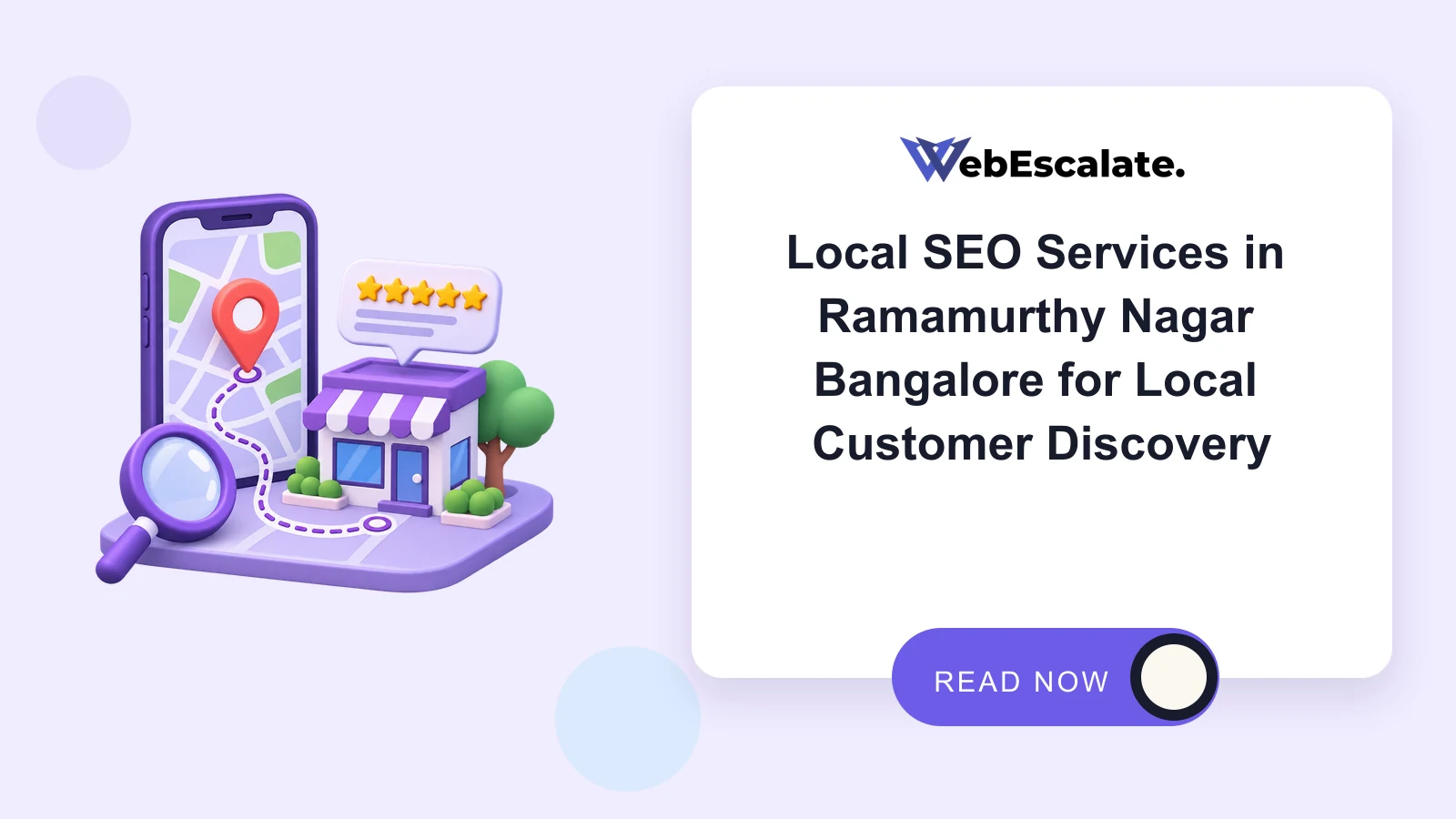
Local SEO services in Ramamurthy Nagar Bangalore should help a nearby customer understand what a business does, where it genuinely operates, and how to contact it. That sounds simple. In practice, the answer is spread across a Google Business Profile, the company website, reviews, directories, maps and enquiry tracking. When those records disagree, customers hesitate and search engines have a harder time matching the business to the query.
This guide is for clinics, professional firms, retailers and service businesses that want more useful local discovery without inventing an address, stuffing locality names into pages or promising a Maps position. It explains the work that can be checked: profile accuracy, service-page quality, review handling, local consistency and lead measurement.
Local SEO services in Ramamurthy Nagar Bangalore start with eligibility
A Business Profile is not a blank marketing page. Google says a business must have a location customers can visit or travel to customers where they are. A service-area business should use one profile for its real central office or location; a virtual office is not eligible unless it is staffed during business hours. The profile should represent the business as it exists in the real world, with an accurate address or service area. These rules matter before category selection, photos or review requests.
For a Ramamurthy Nagar campaign, the first job is therefore an evidence check. Confirm the trading name, customer-facing phone number, website, hours, primary category and actual operating model. Decide whether customers visit the location, the team travels to customers, or both. If the address must be hidden, set the service area correctly instead of publishing a residential or borrowed address. Google’s Business Profile representation guidelines and service-area guidance should be the reference, not a competitor’s listing.
WebEscalate’s Google Maps optimisation service can help structure this audit. It cannot buy or guarantee a position. Google states that local results are mainly shaped by relevance, distance and prominence, and that there is no way to request or pay for a better local ranking.
Make the profile and website tell the same story
A complete profile is useful only when the linked website supports it. The business name, phone, opening hours and service description should agree. The website should make the principal service easy to find, explain who it is for, and give the visitor a clear next step. A broad page that lists every possible service usually answers less than a focused page with scope, process, limits and proof.
For each important service, document:
- the customer problem the service addresses;
- who is a suitable customer and who is not;
- the deliverables or work stages that can be described truthfully;
- the areas actually served, based on operational coverage;
- the evidence available, such as approved photos, credentials or case material;
- the enquiry route, including phone, form, appointment or directions.
This is where search engine optimisation and website development meet. Search research identifies the language customers use. Page design turns that intent into an understandable decision path. The page should not pretend that repeating “Ramamurthy Nagar” proves local relevance. A customer needs accurate coverage, a suitable service and a reliable way to reach the business.
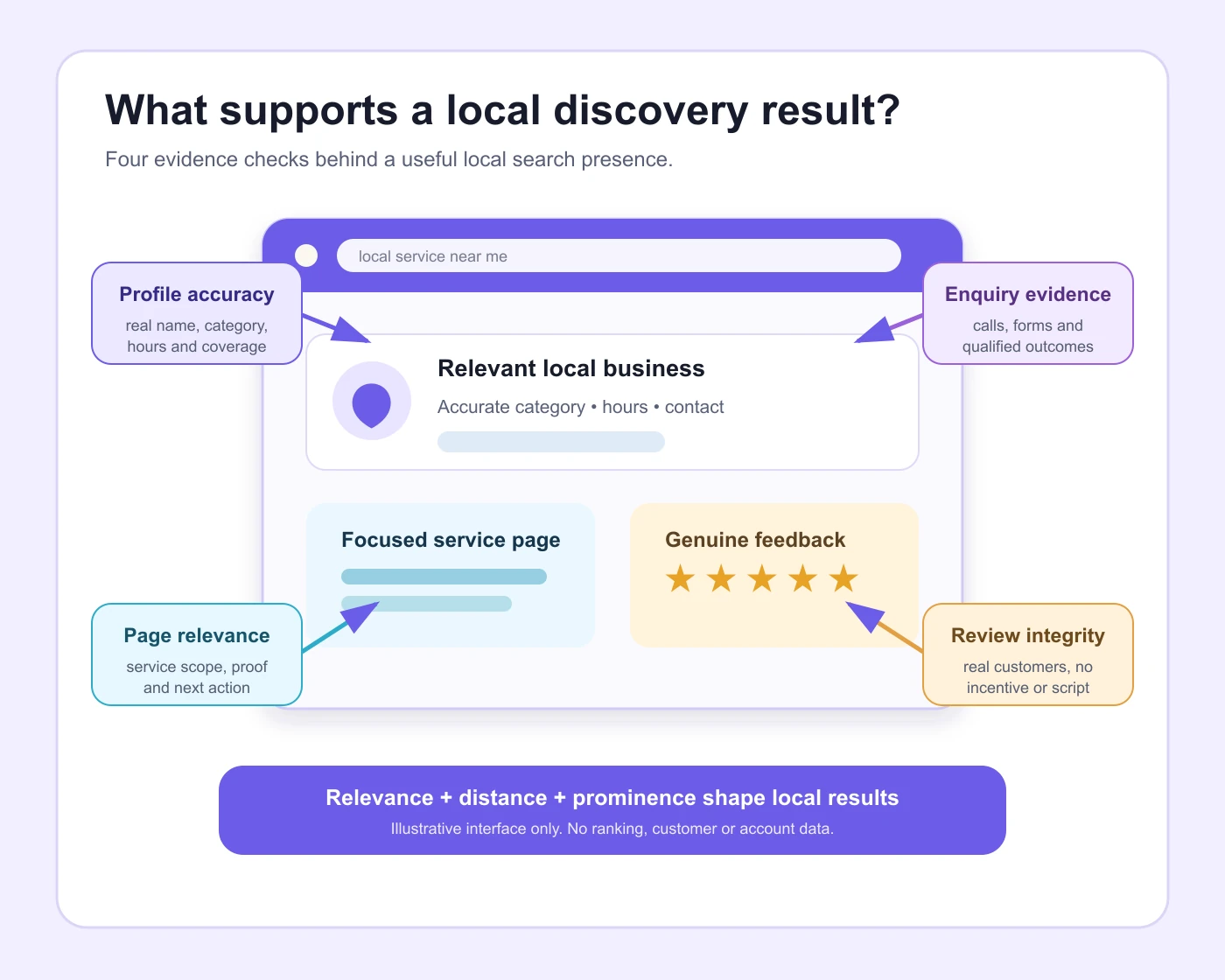
Use a four-part local discovery check
The visual above separates four checks that are often mixed together. Each answers a different question.
1. Can the customer trust the business information?
Check the name, category, phone, website, hours and location settings. Remove duplicate or old records where the owner has authority to do so. Keep special hours current. Google explains that profile information may come from the business, public web content, licensed data and user contributions, so the website and profile need regular review. The aim is not identical wording everywhere; it is a consistent set of facts.
2. Does the page answer the service query?
A local landing page should do more than swap a neighbourhood name into a template. Describe the service, buying considerations, process, limitations and evidence that matter to that audience. Link it to the broader Bangalore service page so visitors can understand the relationship. Avoid producing several pages that answer the same question with only a different locality in the heading. That creates thin coverage and makes it unclear which page should rank.
3. Are reviews handled honestly?
Ask real customers for feedback without offering incentives or telling them what rating to leave. Respond to useful criticism with a clear next step, and do not expose private customer information. Google’s review guidance explains how businesses can request and respond to reviews. Reviews can help a customer decide; they are not a substitute for accurate service information.
4. Can the business trace a useful enquiry?
Record phone clicks, submitted forms, appointment requests and direction actions where the platform makes them available. For links placed in campaigns or profile fields, use consistent UTM parameters. Google Analytics recommends using utm_source, utm_medium and utm_campaign in custom campaign URLs. The campaign URL guidance explains the format. Keep personal or sensitive details out of URLs.
Build location relevance without making a false local claim
A business does not need to claim an office in every locality it serves. If WebEscalate or any client does not have a staffed Ramamurthy Nagar location, the page must not imply otherwise. It can state the real operating model, describe verified service coverage and give customers a direct route to confirm availability.
Useful local context comes from the buying situation. A clinic may need appointment and direction accuracy. A home-service team may need a clear service boundary and rapid phone handling. A professional firm may need consultation eligibility, documents required and response ownership. Those details help a visitor decide whether to enquire. Street names copied from a map do not.
Local structured data also needs restraint. Google’s LocalBusiness structured data documentation says the marked-up information must follow Search Essentials and structured-data guidelines. Use a real address only for a physical location. Do not create ratings, coordinates, opening hours or branches that the business cannot verify. Structured data can help machines understand existing facts; it does not create eligibility or guarantee a rich result.
What a practical engagement should deliver
Before hiring an agency, ask for deliverables that can be inspected. A sensible first phase may include:
- a Business Profile eligibility and accuracy review;
- a record of approved corrections, categories, services and hours;
- a website-to-profile consistency check;
- a focused service-page brief based on the intended query;
- a duplicate and cannibalisation review before new pages are added;
- a review-request and response process that follows platform rules;
- an enquiry measurement plan with named owners and test evidence;
- a report separating completed work, observed change and unresolved risk.
Ask what will not be done as well. The proposal should rule out fake addresses, review incentives, copied locality pages, business-name keyword stuffing and guaranteed rankings. It should explain which changes require owner approval and how access will be removed or transferred at handover.
Measure discovery, actions and qualified outcomes separately
Rank reports are only one view. A local search programme should separate three stages:
- Discovery: the queries, pages and profile views that bring the business into consideration.
- Action: calls, website visits, form starts, direction requests or appointment clicks.
- Outcome: enquiries that match the service, become appointments or enter a real sales process.
The last stage needs input from the business. Marketing tools cannot decide whether a lead was suitable unless sales or operations records the result. Use a small status list such as qualified, unsuitable, duplicate, no response and won. Review the definitions before comparing channels. Do not upload sensitive customer details to advertising or analytics systems without a lawful, approved process.
Google’s own local ranking explanation recommends keeping information complete and accurate, responding to reviews and adding useful photos. It also makes clear that distance is part of local ranking. A report should therefore avoid presenting every movement as the result of one optimisation change. Seasonality, competition, query wording and the searcher’s location can all change what appears.
Questions to ask before choosing a local SEO provider
- Will you check profile eligibility before editing the address or service area?
- How will you prevent this page from competing with our Bangalore or nearby-location pages?
- Which facts, photos and claims need written approval?
- How will calls and forms be tested after tracking changes?
- Who owns the profile, analytics property, tag container and reporting account?
- What happens if Google rejects an edit or asks for verification?
- How will you separate visibility, enquiries and qualified business outcomes?
The useful answer is a process, not a ranking promise. It should show how the agency finds and corrects inaccurate data, strengthens the relevant page, handles access and measures enquiries without inventing certainty.
Common questions from Ramamurthy Nagar businesses
How quickly will local SEO produce a result?
There is no defensible universal timeline. A wrong phone number can be corrected quickly, while verification, recrawling, review growth and competitive visibility take different amounts of time. Ask the provider to separate implementation dates from observation dates. A report should say what changed, when it changed and what happened afterwards without claiming that one edit caused every movement.
Should a business create a page for every Bangalore neighbourhood?
No. Create a location page only when the business genuinely serves that area and the page can answer a distinct customer need. A near-duplicate set of pages with swapped place names gives users little reason to choose one and may compete internally. The broader Bangalore page should own city-level intent; a Ramamurthy Nagar page should provide a narrower buyer context and link back to that pillar.
Does a service-area setting make the business rank everywhere listed?
No. A service area describes where the business operates; it does not override distance or guarantee visibility. Google says distance remains one of the main local ranking factors. Use accurate service areas for customer clarity, then improve relevance and prominence with complete information, useful pages, genuine reviews and a consistent real-world presence.
What should local SEO services in Ramamurthy Nagar Bangalore report each month?
The report should cover completed changes, unresolved accuracy issues, landing-page performance, profile actions where available, enquiry tests and qualified outcomes supplied by the business. It should also record verification requests, rejected edits or tracking gaps. A short report that distinguishes evidence from interpretation is more useful than a long list of rankings without context.
Plan a safe Ramamurthy Nagar local SEO review
Begin with the facts the business can prove. Then compare the profile, website and measurement setup against them. Prioritise errors that mislead customers or block contact before expanding content. Once the basics are dependable, add a focused page only when it owns a distinct search intent and gives the reader information the broader Bangalore page does not.
If you want WebEscalate to review the profile, service pages and enquiry path, use the contact page. Share the real business location or service model, core services and current measurement setup. The review should begin with eligibility and evidence, not with a promise to place the business at a particular position.