An AI automation agency in Bangalore should begin with the work that is slowing a team down. The problem may be delayed lead follow-up, repeated data entry, support requests that reach the wrong person, or documents that staff review in the same way every day. A useful project maps that process, chooses a limited role for AI, and keeps people responsible for sensitive decisions.
WebEscalate provides workflow automation services that can connect forms, inboxes, customer systems, spreadsheets, databases, and approval steps. The right design depends on the existing process and data. It also needs a clear answer for what happens when the model is uncertain, a connected service is unavailable, or a person needs to stop the workflow.
What an AI automation agency in Bangalore should do
An agency should study the current workflow before recommending a model or automation platform. That review identifies the trigger, inputs, decisions, systems, exceptions, owners, and expected result. It also separates predictable rules from tasks that may benefit from AI interpretation.
An AI automation agency in Bangalore should explain that split in the proposal. The client can then see where a model interprets information and where fixed logic controls the outcome.
Fixed automation works well for exact steps such as checking whether a required field exists, assigning a record from a known territory, or sending an approved notification. AI may help when the input varies, such as classifying an enquiry, extracting details from a document, summarising a conversation, or drafting a response. The final workflow can use both.
WebEscalate’s workflow automation service covers process discovery, workflow design, implementation, monitoring, and support. A proposal should still name the actual systems, controls, and deliverables for the selected project.
Choose the first workflow from measurable friction
Start with a process that happens often and has a visible owner. Staff should be able to describe its current steps, common exceptions, and final output. Record a baseline before changing it: completion time, backlog, correction rate, response delay, or another measure that reflects the real bottleneck.
Use a short scorecard to compare candidate workflows:
- Frequency: how often the process runs.
- Consistency: whether the inputs and expected outputs are reasonably stable.
- Impact: the cost of delay, rework, or missed follow-up.
- Data readiness: whether required records are available and usable.
- Reversibility: whether an incorrect action can be corrected safely.
- Ownership: who reviews the output and handles exceptions.
A first release is easier to govern when the action is reversible and the owner can review a limited volume. High-impact decisions involving payments, contracts, employment, health, legal matters, or access rights need stronger controls and may be poor starting points.
Practical AI automation examples for Bangalore businesses
Lead intake and routing
A workflow can collect a website or WhatsApp enquiry, check required details, classify the service request, create a CRM record, and notify the correct owner. The original message should remain available beside the summary. Rules can catch duplicates and route low-confidence classifications to staff.
Support request triage
AI can suggest a category, priority, knowledge article, or draft response. Billing disputes, complaints, account changes, and unclear requests can move to a person. The workflow should show the source message and the reason for the suggested route so a reviewer can correct it.
Document processing
An automation can extract fields from invoices, forms, service reports, or proposals. Validation rules should check formats, totals, required fields, and duplicates before another system receives the data. Inconsistent records belong in an exception queue, not in a silent retry loop.
Internal reporting and follow-up
A workflow can collect approved records, prepare a recurring summary, and assign follow-up tasks. Source values should remain separate from generated commentary so staff can trace every figure. An AI-written explanation should never replace the underlying business record.
These examples describe possible workflows. They are not claims about completed WebEscalate client projects or measured savings.
Design a controlled workflow around the AI step
The model is one component inside a wider process. Inputs need validation, tools need limited permissions, outputs need checks, and every live action needs an owner. An AI automation agency in Bangalore should show this full path rather than presenting a prompt as the finished system.
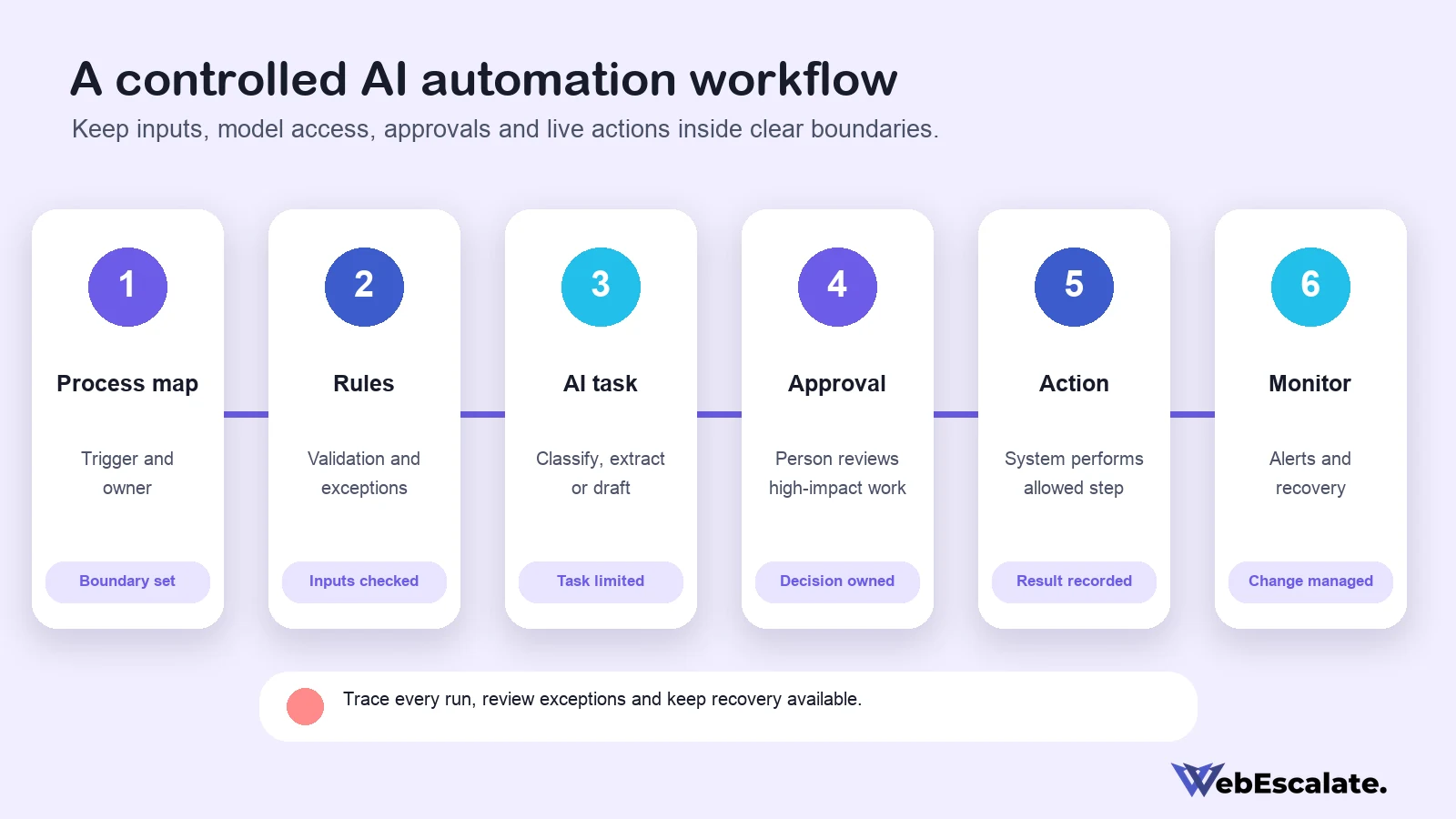
NIST’s voluntary AI Risk Management Framework organises AI risk work around govern, map, measure, and manage. The approach fits business automation: define responsibility, understand the context, evaluate the system, and manage problems throughout its use.
The design document should list each step, the data it reads, the action it can request, the conditions for approval, and the record created after completion. This gives the business a practical basis for testing and future changes.
For an AI automation agency in Bangalore project, this document also creates a shared reference for staff, developers, and the person who will own the live workflow.
Place human approval where consequences rise
Approval screens work best when the reviewer has a specific decision. Show the original input, proposed action, relevant source records, and the reason the item needs attention. Give the reviewer clear options to approve, edit, reject, or send the item back for more information.
Keep a person in control before the system sends an external message, changes a customer record, commits spending, publishes content, issues a refund, grants access, or makes another action that is difficult to reverse. Approval requirements can vary with the amount, customer, confidence result, data type, or exception.
The NIST Generative AI Profile notes that generative AI may require different levels of oversight, along with added review, tracking, documentation, and management attention. It also recommends policies that define roles and responsibilities for human and AI configurations.
Define data boundaries before connecting a model
List the fields the workflow needs, where they come from, who can view them, where outputs are stored, and how long logs remain. Avoid sending an entire customer record when the task needs only a few fields. Secrets belong in protected server-side storage and should never appear in prompts, browser code, article content, or routine logs.
Vendor review should cover model providers, automation platforms, hosting, data retention, account ownership, sub-processors, and the method for deleting or exporting records. The NIST Privacy Framework offers a voluntary way to identify and manage privacy risk. Legal duties depend on the organisation, data, people affected, and use case, so qualified counsel should review questions that require legal interpretation.
An AI automation agency in Bangalore proposal should state these data boundaries instead of leaving them for implementation. The same document should explain which accounts the client owns and which subscriptions continue after handover.
Protect connected tools from AI-specific risks
AI systems can receive untrusted instructions through direct prompts, emails, documents, websites, and retrieved content. OWASP describes prompt injection as input that changes model behaviour or output in unintended ways. Retrieval and fine-tuning can improve relevance, but OWASP notes that they do not remove the risk.
Connected tools should expose only the functions required for the workflow. Use the minimum permissions, validate actions in the downstream system, and require approval for high-impact operations. OWASP’s guidance on excessive agency recommends limiting tool functionality, permissions, and autonomy. It also recommends monitoring, rate limits, and human approval for sensitive actions.
A chatbot that answers from approved material may need read access to a knowledge base. It does not need permission to delete records or send messages unless those actions are part of the agreed workflow and have their own controls.
Test the workflow with representative and difficult cases
Testing should use real process shapes without exposing unnecessary personal data. Include normal inputs, missing fields, duplicates, unclear language, unusual formats, conflicting records, unavailable services, and attempts to manipulate the model. Staff who understand the process should review the results.
Define acceptance checks before the pilot. A document workflow might measure required-field accuracy, exception routing, duplicate prevention, and reviewer corrections. A lead workflow might track routing accuracy, response delay, and the share of records that reach the correct owner.
During the pilot, an AI automation agency in Bangalore needs to record failures and reviewer corrections as carefully as successful runs. These cases reveal missing rules and unsafe assumptions before the workload expands.
NIST’s Generative AI Profile recommends pre-deployment testing that reflects the deployment context and continued post-deployment monitoring. A benchmark alone may not show how the system behaves with the organisation’s users, data, and connected tools.
Plan for failures, retries, and recovery
Every API, model, and business system can fail or return incomplete data. The workflow should distinguish a temporary technical error from a record that needs human attention. Temporary connection problems may receive limited retries with increasing delay. Missing information, a policy exception, or a low-confidence result usually belongs in a review queue.
Make’s official error-handling documentation describes handlers, incomplete executions, manual queues, and predefined recovery paths. Whatever platform is selected, the operating plan should name the alert recipient, recovery step, retry limit, and rule for preventing duplicate actions.
Logs should capture a run identifier, time, step, status, approval, and useful error context. Avoid copying full prompts or sensitive records when a reference ID is enough. The owner should be able to pause the workflow and trace what happened to one item.
The support scope from an AI automation agency in Bangalore should state who reviews alerts, what is included in maintenance, and how platform or model changes are tested before release.
Measure the pilot against the old process
Compare the pilot with the baseline recorded during discovery. Useful measures include completion time, exception rate, correction rate, duplicate rate, time in the approval queue, and successful handoffs. Choose measures that reflect the original problem.
Review quality and operating cost together. Model usage, automation-platform fees, human review, monitoring, maintenance, and support all affect the result. Expand the workflow only after the team understands its errors and can recover from them.
The related software development company in Bangalore guide explains requirements, architecture, testing, integration, and ownership for wider business systems. AI automation can sit inside such a system when the workflow requires custom software.
How an AI automation project is delivered
- Discovery: map the current process, owners, inputs, decisions, exceptions, systems, and baseline.
- Workflow design: separate fixed rules, AI-assisted steps, human approvals, and prohibited actions.
- Data and access plan: define fields, credentials, permissions, retention, vendors, and account ownership.
- Pilot build: connect a test environment and create validation, exception, retry, and logging paths.
- Evaluation: test representative and adversarial cases against documented acceptance checks.
- Controlled launch: begin with limited users or volume, monitor every exception, and keep rollback available.
- Handover and support: document the workflow, train owners, review changes, and maintain integrations.
The handover should include a process diagram, connection inventory, permission list, model and platform settings, approval rules, test cases, known limits, recovery steps, and change history.
How to compare AI automation agencies in Bangalore
Ask each agency to explain the workflow in business terms before discussing tools. A useful proposal names the first process, current baseline, systems, data, AI task, approval points, exceptions, tests, operating measures, ownership, and support scope.
- Which part needs AI, and which parts use ordinary rules?
- What data reaches the model and where is it retained?
- Which actions can the system request or perform?
- Where can staff review, correct, pause, or override it?
- How are prompt injection, excessive permissions, and duplicate actions handled?
- What happens when a model, API, or connected tool fails?
- Which accounts, workflow definitions, code, and documentation does the client own?
- What costs and maintenance continue after launch?
Avoid proposals built around an unverified saving or a promise of full autonomy. The agency should show how the workflow will be measured and where human responsibility remains. WebEscalate’s services overview connects automation with website, software, and marketing work when those areas belong in the same project.
Frequently asked questions
How does an AI automation agency work?
The agency maps a process, identifies suitable automation steps, connects approved systems, tests the workflow, and supports it after launch. AI may classify, extract, summarise, or draft. Rules, permissions, approvals, logs, and recovery steps control how the output is used.
Is an AI automation agency worth it?
It may be worthwhile when a repeated process has a clear owner, stable inputs, measurable friction, and enough volume to justify implementation and support. Compare the pilot with the existing process and include platform fees, model usage, review time, maintenance, and failure recovery in the decision.
What business process should be automated first?
Choose a frequent workflow with visible delays or rework, a responsible owner, and an output that can be checked. Lead routing, support triage, document extraction, and recurring internal follow-up are common candidates. Avoid starting with an unclear or high-impact decision.
Can AI automation work with existing business software?
It can often connect through APIs, webhooks, approved platform connectors, databases, or custom integration code. Feasibility depends on access, authentication, data quality, rate limits, and the actions the existing system exposes. Discovery should verify those details before the estimate is final.
How much does AI automation cost in Bangalore?
Cost depends on workflow complexity, systems, data preparation, custom interfaces, security, testing, usage fees, monitoring, and support. Ask the proposal to separate discovery, implementation, third-party subscriptions, model usage, maintenance, and future changes. WebEscalate provides an estimate after reviewing the process and dependencies.
How long does an AI automation project take?
The schedule depends on access, process clarity, exception volume, integration limits, testing, and approval speed. A focused pilot can be estimated more reliably than a broad request to automate a department. The delivery plan should state assumptions and identify anything that can block the launch.
Plan one controlled workflow
An AI automation agency in Bangalore should make the process, boundaries, tests, approvals, and ownership visible. Start with one measurable bottleneck, keep the first release narrow, and expand after staff can review exceptions and recover from failures.
Businesses can also review WebEscalate’s Bangalore web development hub when the workflow includes a customer-facing website or portal. Contact WebEscalate to discuss the process, systems, data, approval needs, and a practical first pilot.