
Website redesign services in Richmond Town Bangalore should make a professional-services firm easier to assess before a prospect makes contact. A polished interface helps, but buyers also need a clear service scope, credible proof, understandable expertise, and an enquiry path that respects the time they have already spent researching.
This guide is for consultancies, legal and accounting practices, advisory firms, architects, clinics, and other expertise-led businesses evaluating an existing website. It explains how to audit the current site, plan the page structure, protect search visibility, improve accessibility and performance, and measure enquiries after launch. It does not assume a Richmond Town office or promise a ranking, lead volume, or conversion increase.
What Website Redesign Services in Richmond Town Bangalore Should Fix
A redesign brief should begin with a business problem. Professional-services websites often struggle because several issues overlap: service pages use internal terminology, partner expertise is hard to verify, project proof lacks context, mobile navigation slows comparison, and contact forms collect information the firm does not need.
List the decisions a serious prospect must make on the site. They may need to identify the relevant service, understand who will handle the work, see the type of engagement the firm accepts, review evidence, and know what happens after an enquiry. That list gives the redesign a useful boundary.
A visual refresh without page-level evidence may leave the same buying friction behind. The broader website redesign services Bangalore guide covers the city-wide process. This Richmond Town article focuses on professional-services evaluation and the proof needed on individual pages.
Audit the Current Website Before Designing Screens
Start with an inventory of every public URL. Record the page purpose, search traffic, important queries, backlinks, enquiry role, owner, and whether the content is still accurate. Mark each URL as keep, improve, merge, redirect, or remove. This prevents a redesign team from deleting a quiet page that supports a client conversation or earns useful search visibility.
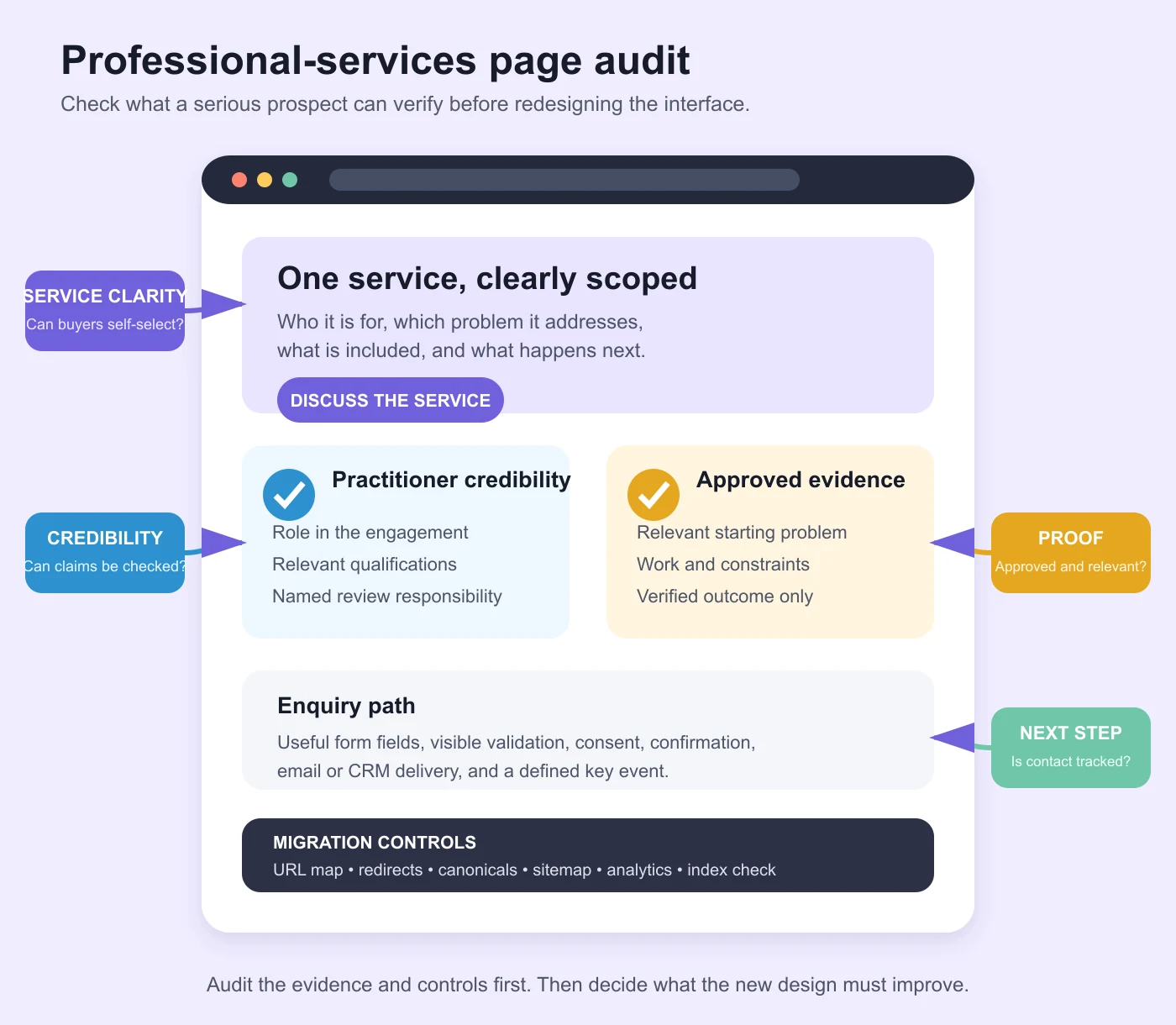
Review representative pages on a phone and desktop. Look for service descriptions that begin with the firm rather than the client’s problem, biographies without relevant credentials, proof that cannot be connected to a service, and forms with unclear confirmation states. Check whether a visitor can complete the important tasks with a keyboard and whether headings, links, and labels still make sense without visual context.
Capture a baseline before making changes. Useful evidence includes Search Console landing-page data, analytics events, qualified enquiries, call or meeting actions, form completion, page speed, and recurring questions from prospects. A baseline cannot prove causation on its own, but it gives the team a stable point for post-launch comparison.
Build Service Pages Around Evaluation Questions
One service page should answer one coherent group of buyer questions. The page needs a plain-language scope, the situations it addresses, the people involved, the working process, relevant evidence, practical limits, and a useful next step. Splitting one service across thin location pages weakens the explanation and can create overlapping search intent.
Professional-services buyers often compare risk as much as capability. They want to know whether the firm has handled a similar situation, which assumptions shape the engagement, what the client must provide, and how decisions will be documented. Publish only evidence that the firm has permission to use. If a named case study is unavailable, explain the method accurately instead of inventing a result.
Keep related expertise connected. A redesign may require development work, analytics, search migration, or workflow integration. WebEscalate’s website development services describe the wider build capability, while this page stays focused on improving an existing professional-services site.
Make Credentials and Proof Easy to Verify
Claims such as experienced, trusted, or leading tell a visitor very little on their own. Replace broad claims with checkable information: named qualifications, relevant responsibilities, published methods, approved client evidence, documented sectors, or a clear explanation of how the work is reviewed.
Place proof close to the claim it supports. A service page about regulatory work should not depend on a general testimonial from an unrelated project. A project summary should state the starting problem, the work completed, the constraints, and the outcome only when those facts are approved. Avoid presenting a composite scenario as a real client story.
Biographies also need a reason to exist within the buying path. Include the person’s role in the service, relevant background, and the point at which a client will work with them. This helps a prospect understand the delivery team without forcing them to search several disconnected pages.
Plan Navigation for a Busy Prospect
Navigation should use the language prospects recognize. Broad labels such as solutions or capabilities can hide the difference between services. Clear service names, industry routes when genuinely distinct, people, evidence, resources, and contact information are easier to scan.
Test the path from likely landing pages across the site. A visitor arriving from search may begin on a service article, a profile, or a case study instead of the homepage. Each page should provide enough context to continue without forcing a return to the main menu.
Use internal links where they answer the next question. A page about design should point to the relevant build or measurement resource, not to every service the company offers. The digital marketing agency Bangalore guide explains how demand reaches a site; the redesigned site still has to help that visitor evaluate the offer.
Include Accessibility in the Redesign Scope
Accessibility affects the whole interface, not a final compliance scan. The W3C’s Web Content Accessibility Guidelines 2.2 include testable criteria covering text alternatives, keyboard use, focus, contrast, labels, error handling, target size, and compatible markup. Some checks can be automated, while others require human review.
Test real tasks on responsive pages. A visitor should be able to compare services, read a biography, complete a form, identify an error, and understand the confirmation state. Keyboard focus needs to remain visible. Form labels should describe the requested information, and instructions should not depend on colour alone.
Ask the redesign provider which criteria are included, when testing occurs, and which specialist review remains outside scope. An automated badge cannot establish conformance across every page and interaction.
Set Performance Targets for Representative Pages
Professional-services sites can become heavy through large photography, decorative motion, multiple font files, page-builder effects, and third-party scripts. Set targets before the visual system is approved so performance is treated as a design constraint.
Measure representative templates, including the homepage, a service page, a profile, an article, and the contact path. Google’s Web Vitals measurement guidance distinguishes lab tools used during development from real-user field data. Both views matter because a single laboratory run cannot represent every device, network, or interaction.
Record the current baseline and test again after launch. Avoid promising one score across the whole site. A useful acceptance check states the pages, devices, test conditions, and metrics being reviewed.
Protect Search Visibility During a Website Redesign
A redesign can change copy, navigation, templates, internal links, metadata, and URLs at once. Preserve stable addresses unless there is a clear reason to change them. When a URL must move, map the old page to the closest relevant new destination.
Google’s site-move guidance recommends server-side permanent redirects, updated internal links, correct canonical references, updated sitemaps, and Search Console monitoring. Its separate redirect guidance explains how permanent server-side redirects signal a lasting move. Avoid sending many unrelated pages to one irrelevant destination.
The migration sheet should cover titles, descriptions, headings, structured data, image alternatives, canonical URLs, robots rules, index settings, and links. Remove temporary staging blocks at launch, then inspect important URLs and crawl reports. Search visibility can fluctuate while changed pages are recrawled, so no provider can guarantee unchanged rankings.
Measure Enquiries Instead of Counting Every Click
Define the actions that matter before development begins. Google Analytics describes a key event as an event that measures an action important to the business. For a professional-services firm, that might be a confirmed enquiry, a booked consultation, or a qualified call action with an agreed definition.
Do not mark every page view or contact-button click as a commercial success. Test the complete path, including form validation, consent, submission, confirmation, email delivery, CRM receipt, and source information. If several forms serve different practices, keep their events distinguishable.
After launch, compare matched periods and segment by landing page, channel, device, and enquiry type where the volume allows. Website changes, campaign changes, seasonality, and sales follow-up can all affect the result. The redesign should improve the path and the measurement, not claim credit for every outcome.
A Practical Redesign and Launch Sequence
- Discovery: confirm priority services, audiences, evidence, current performance, technology, and constraints.
- Page audit: inventory URLs, search signals, proof, content owners, analytics, and user tasks.
- Structure: approve the sitemap, page jobs, content outlines, internal links, and URL decisions.
- Design: test hierarchy and interaction in wireframes before applying the full visual system.
- Build: develop reusable components, forms, tracking, integrations, and content templates.
- Migration QA: test redirects, metadata, accessibility, performance, analytics, forms, and responsive layouts.
- Launch review: monitor crawl errors, indexing, field performance, and qualified enquiry actions against the baseline.
Each phase needs an owner and an acceptance check. Approval of a layout should not imply that content, redirects, analytics, or accessibility have been tested. The project plan should also name dependencies such as client copy, legal review, photography, CRM access, and DNS changes.
How to Evaluate a Richmond Town Redesign Provider
Ask providers to explain the evidence behind their finished screens. Useful questions include:
- Which data will determine the scope and page priorities?
- Who owns copy, evidence approval, design, development, content entry, and QA?
- How will existing URLs, rankings, links, and high-value pages be protected?
- Which accessibility and performance tests are included?
- How will forms, key events, CRM delivery, and confirmation states be verified?
- What staging, backup, rollback, training, warranty, and support are included?
- Which comparable evidence can be reviewed with client permission?
A proposal should separate included work, assumptions, client responsibilities, third-party costs, and optional items. It should not rely on a location phrase as proof of local experience. Confirm the team, delivery method, and evidence directly.
Frequently Asked Questions
What is included in professional website redesign services?
Scope may include research, analytics review, content inventory, information architecture, wireframes, visual design, copy support, development, accessibility checks, performance work, integrations, SEO migration, tracking, QA, launch, and monitoring. Request a written list because packages differ.
How much does a website redesign cost in Richmond Town Bangalore?
Cost depends on page count, research, content work, custom design, development complexity, integrations, migration risk, testing, and support. A useful estimate states assumptions and third-party costs. No fixed WebEscalate price is claimed here because an approved scope has not been provided.
How long does a professional-services website redesign take?
Timing depends on scope, decision speed, content readiness, evidence approval, integrations, migration, and QA. Ask for milestones and client dependencies rather than one fixed duration for every project.
Can a website redesign reduce Google rankings?
Yes. Rankings can change when URLs, content, internal links, templates, metadata, or index settings change. A content inventory, redirect map, metadata transfer, crawl checks, sitemap updates, and Search Console monitoring reduce avoidable risk, but they do not guarantee unchanged positions.
Should every service have a separate page?
Create a separate page when the service has a distinct buyer problem, scope, evidence, and search intent. Combine pages that promise the same outcome to the same audience. This keeps navigation useful and reduces overlapping content.
Plan the Redesign Around Evidence
Website redesign services in Richmond Town Bangalore are easier to evaluate when the proposal connects each page and design decision to a buyer task, approved evidence, a technical check, or a measurable action. That approach gives professional firms a clearer site without discarding working search signals or hiding unfinished measurement.
To scope an existing website, share the current URL, priority services, known problems, content owners, and available analytics through the WebEscalate contact page. The first discussion should establish what needs to improve, what must be protected, and how the result will be checked.