
Website redesign services Bangalore businesses choose should solve a defined commercial problem. A dated look may be visible, yet the harder issues often sit underneath it: visitors cannot find the right service, mobile pages are slow, forms ask too much, or nobody can tell which pages produce enquiries. A useful redesign starts with evidence from the current site, protects what already works, and gives the team a clear way to measure the new version.
This guide explains how to plan that work without treating a new visual style as the whole project. It covers lead paths, structure, accessibility, performance, SEO migration, analytics, launch QA, and post-launch review. It also shows what a Bangalore business should ask before selecting a redesign partner.
What Website Redesign Services Bangalore Businesses Actually Need
A redesign can range from a focused improvement to a full rebuild. The correct scope depends on the problem. A service company may need clearer service pages and shorter enquiry forms. An ecommerce business may need faster product discovery and a cleaner checkout path. A software company may need better product explanations, demo requests, and documentation.
Good website redesign services Bangalore buyers can evaluate usually include five connected workstreams:
- Research into current traffic, enquiries, user paths, content, and technical issues.
- Information architecture and page planning around buyer questions.
- UX and visual design for mobile and desktop use.
- Development, performance work, accessibility checks, and integrations.
- SEO migration, analytics validation, launch QA, and follow-up monitoring.
If the proposal covers colours and layouts but leaves out URLs, forms, tracking, and launch checks, the commercial risk remains with the client. WebEscalate’s Bangalore web development service provides the broader build context, while this redesign process focuses on improving an existing site.
Start With a Baseline Before Changing the Website
The first deliverable should be a baseline, not a homepage concept. Record what the current site does before changing it. Otherwise, a business cannot separate a real improvement from a seasonal change, a new advertising campaign, or a temporary traffic shift.
Useful baseline data includes:
- Organic clicks, impressions, queries, and important landing pages from Search Console.
- Sessions and enquiry actions by channel and landing page.
- Form submissions, qualified calls, booked meetings, and other agreed key events.
- Pages that already earn links, rankings, or assisted conversions.
- Mobile and desktop performance from lab tests and available field data.
- Common user questions from sales calls, support messages, and on-site search.
Google Analytics defines a key event as an action that matters to the business. For a service site, that could be a successful form submission, a booked consultation, or a call-click that meets an agreed rule. The event definition should be written down before launch and tested again on the new site. Generic form tracking is not enough when several forms serve different purposes.
Build the Redesign Around the Lead Path
A visitor rarely lands on a website ready to contact a company without context. The page has to answer a sequence of questions: Is this service relevant? Does the provider understand the problem? What is included? What evidence supports the claim? What happens after contact?
Map that sequence for each priority service. A strong service page usually needs a clear scope, the problems it addresses, the process, relevant proof, realistic limitations, common questions, and one obvious next step. The contact option should appear when the visitor has enough information to act. Repeating the same call-to-action after every paragraph adds noise.
This is where redesign and marketing connect. The digital marketing agency Bangalore guide explains how channels attract demand. The redesigned site must then help the right visitor understand the offer and submit a useful enquiry.
Plan Navigation and Service Pages Around Buyer Questions
Navigation should help a first-time visitor choose a path without learning the company’s internal language. Broad labels such as Solutions can hide the services buyers actually seek. Clear service names, industry routes when relevant, proof, resources, and contact information are easier to scan.
Keep one primary page for each distinct service intent. Combine pages that promise the same outcome to the same audience. Separate them when scope, buyer questions, and proof are materially different. This reduces content overlap and gives internal links a clear destination.
A content inventory makes the decision practical. Mark each current URL as keep, improve, merge, redirect, or remove. Record its traffic, search visibility, backlinks, conversion role, owner, and destination. This prevents a design team from deleting a quiet page that still supports rankings or a sales conversation.
Make UX and Accessibility Part of the Scope
UX review should include real tasks. Can a mobile visitor compare services, read the pricing approach, reach a form, correct an error, and confirm that the submission worked? Can a keyboard user see focus and move through navigation in a logical order? Are headings and form labels meaningful without relying on colour or position?
The W3C’s WCAG 2.2 recommendation covers areas such as text alternatives, contrast, keyboard access, focus visibility, target size, labels, and accessible authentication. Conformance needs testing across complete pages and responsive variations. A plugin badge or automated scan cannot prove that every requirement is met.
For website redesign services Bangalore teams compare, ask how accessibility will be checked during wireframes, component development, content entry, and final QA. Fixing these issues at the end is slower because problems may be built into the component system.
Improve Mobile Performance With Measured Targets
Performance belongs in the design brief. Large hero media, multiple font files, heavy page-builder effects, third-party scripts, and unreserved image space can make a polished page feel slow or unstable.
Google’s current Core Web Vitals guidance describes three field metrics: Largest Contentful Paint for loading, Interaction to Next Paint for responsiveness, and Cumulative Layout Shift for visual stability. The recommended thresholds are 2.5 seconds or less for LCP, 200 milliseconds or less for INP, and 0.1 or less for CLS.
Use lab testing during development to catch regressions, then review real-user field data after launch. The web.dev measurement guide explains why both views matter. A single desktop score does not represent every visitor, device, network, or page template.
Protect Search Visibility During the Redesign
A redesign can change copy, templates, navigation, internal links, metadata, and URLs at the same time. That creates SEO risk even when the new design looks better. Preserve important content and avoid changing stable URLs without a clear reason.
If URLs must change, create a one-to-one map from each old address to the closest relevant new address. Google’s site-move guidance recommends permanent server-side redirects, updated internal links, correct canonicals, updated sitemaps, and monitoring in Search Console. It also advises keeping redirects for as long as possible, generally at least one year.
Redirecting every retired page to the homepage is a poor substitute for mapping. Google warns that irrelevant bulk redirects can confuse users and may be treated as soft 404s. The migration sheet should also track title tags, meta descriptions, headings, structured data, image alt text, canonical URLs, index rules, and internal links.
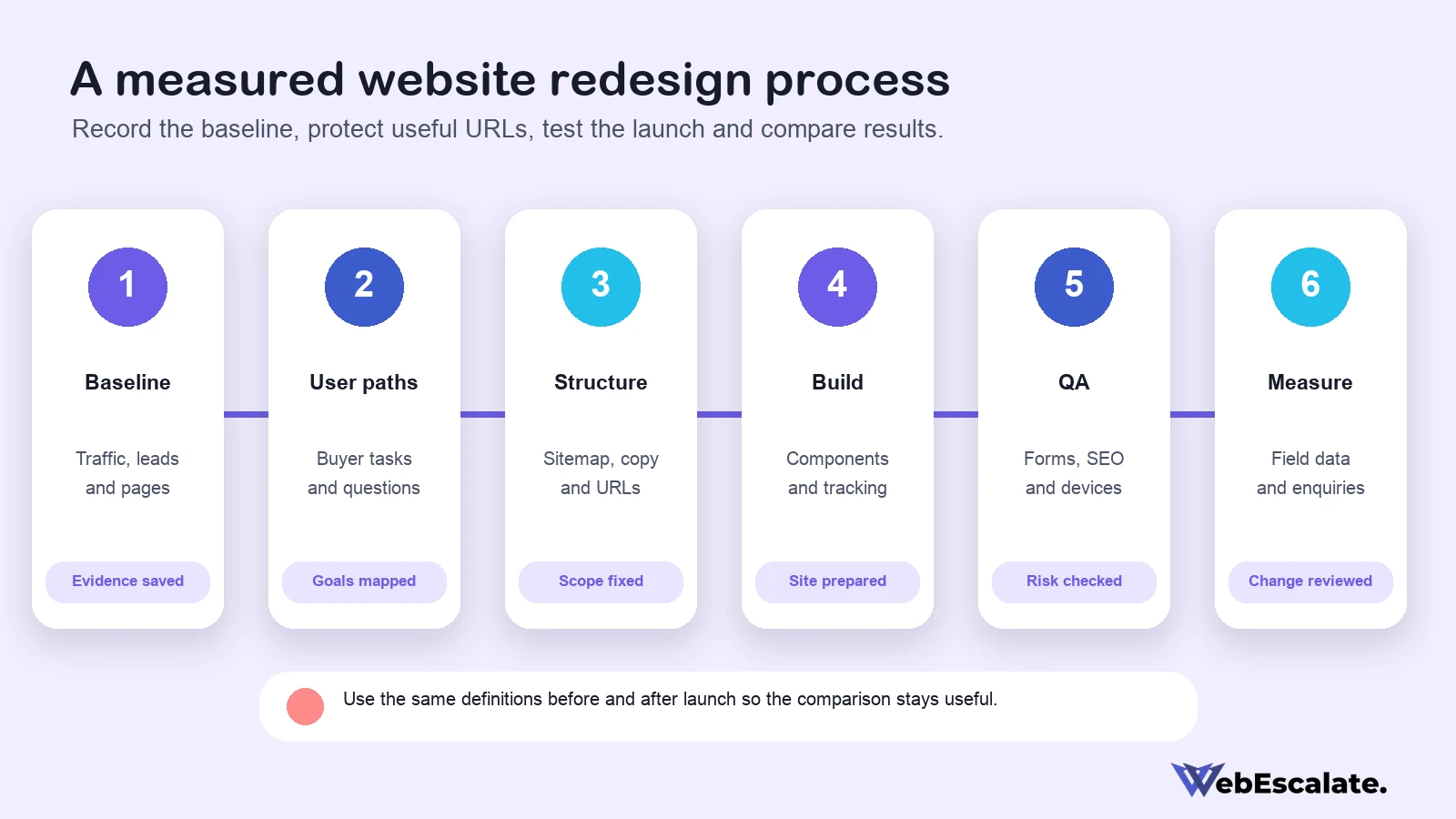
A Practical Website Redesign Process
A clear process reduces expensive revisions and gives each decision an owner. A practical sequence looks like this:
- Discovery and baseline: document business goals, priority audiences, current performance, content, technology, and constraints.
- User paths and scope: decide which tasks matter, which pages support them, and what the project will leave unchanged.
- Structure and content: create the sitemap, URL decisions, section outlines, redirect map, and copy responsibilities.
- Wireframes and visual system: solve hierarchy and interaction first, then apply the approved brand system.
- Development and integration: build reusable components, forms, analytics, CRM connections, consent controls, and content templates.
- QA and migration: test devices, browsers, forms, accessibility, metadata, redirects, tracking, and performance in staging.
- Launch and review: monitor errors, indexing, enquiries, and field performance against the recorded baseline.
The sequence can adapt to the size of the site, but approvals should remain visible. A signed wireframe should not hide unfinished copy, and a signed design should not imply that analytics or redirects have been tested.
When reviewing website redesign services Bangalore proposals, connect every phase to a named deliverable, reviewer, and acceptance check. That keeps scope decisions visible before they become development changes.
Run Launch QA Before Traffic Reaches the New Site
Use a staging environment that search engines cannot index, then remove temporary blocks as part of the launch checklist. Test the final content and production integrations, not only sample pages.
Before launch, verify:
- Priority pages, navigation, search, forms, emails, calls, downloads, and confirmation states.
- Mobile layouts, keyboard navigation, focus, contrast, form labels, and error messages.
- Page titles, descriptions, headings, canonicals, structured data, sitemaps, robots rules, and index settings.
- Old-to-new redirects and internal links against the approved URL map.
- Analytics tags and agreed key events in production-like conditions.
- Performance on representative templates, especially the homepage, service pages, articles, and contact path.
- Backups, rollback ownership, DNS or hosting steps, and monitoring responsibilities.
A launch decision should record any accepted exceptions and the person responsible for each follow-up. That makes the first week manageable when an issue appears.
Measure Leads and Performance After Launch
The first review should compare matched periods and segment the data. Check channel, landing page, device, location, and enquiry type where volume allows. Total traffic can rise while qualified enquiries fall, and a strong campaign can hide a weak page.
Review technical signals daily during the first few days, then use weekly and monthly checkpoints. Look for crawl errors, redirect failures, missing tags, form problems, unexpected traffic drops, and Core Web Vitals changes. Search rankings may fluctuate after material URL changes while Google recrawls the site, so avoid judging the project from one day of data.
For website redesign services Bangalore businesses commission, the measurement plan should state which outcomes belong to the site and which depend on traffic quality, sales follow-up, pricing, and market demand. A redesign can improve the path to enquiry; it cannot guarantee lead volume or revenue.
How to Evaluate a Website Redesign Company in Bangalore
Ask every provider to explain the deliverables in concrete terms. Useful questions include:
- Which evidence will determine the scope?
- Who owns research, copy, design, development, content entry, and approvals?
- How will current URLs, rankings, backlinks, and high-performing pages be protected?
- Which accessibility checks are included, and which still need specialist testing?
- How will mobile performance be tested during development and after launch?
- Which forms and key events will be validated?
- What staging, backup, rollback, training, warranty, and support are included?
- What evidence can be reviewed, with client permission, for a comparable project?
A proposal should separate included work from assumptions and optional items. It should also identify third-party costs such as hosting, licences, paid integrations, photography, translation, or ongoing optimisation. WebEscalate’s services overview shows the connected development, marketing, and automation capabilities that may support a redesign.
Compare website redesign services Bangalore providers on the evidence they request, the migration risks they document, and the way they verify the final site. A low-detail quote may leave essential content, tracking, or QA outside the price.
Frequently Asked Questions
What is included in website redesign services?
The scope may include research, analytics review, a content inventory, sitemap, wireframes, visual design, copy support, development, accessibility checks, performance work, integrations, SEO migration, analytics validation, QA, launch, and monitoring. Ask for a written list because packages vary.
When should a business redesign its website?
Consider a redesign when the current site blocks important buyer tasks, no longer represents the service, performs poorly on mobile, is hard to maintain, or cannot support required tracking and integrations. If the problem is limited to one page or campaign, a focused improvement may be more appropriate.
How much does a website redesign cost in Bangalore?
Cost depends on page count, content work, custom design, development complexity, ecommerce or CRM integrations, migration risk, testing, and post-launch support. A useful estimate states assumptions and third-party costs. This article does not claim a fixed WebEscalate price because an approved scope has not been supplied.
How long does a website redesign take?
Timing depends on scope, decision speed, content readiness, integrations, data migration, and QA. Ask for milestones covering discovery, structure, design, content, development, testing, and launch. The schedule should name client dependencies rather than promise one fixed duration for every site.
Can a redesign affect SEO rankings?
Yes. Rankings may change when URLs, content, internal links, templates, or index settings change. Reduce risk with a content inventory, redirect map, metadata transfer, internal-link updates, crawl checks, sitemap updates, and Search Console monitoring. No provider can guarantee unchanged rankings.
How should redesign results be measured?
Record a baseline for qualified enquiries, key events, important landing pages, search visibility, and field performance. After launch, compare matched periods and segment by channel, page, device, and enquiry type. Keep the measurement method stable long enough to interpret the change.
Plan the Redesign Around Evidence
A website redesign should leave the business with more than new screens. It should produce a clearer service structure, a tested lead path, protected search signals, dependable tracking, and a practical plan for ongoing improvement.
To discuss website redesign services Bangalore businesses can scope around current evidence, share the existing site, priority services, known problems, and available analytics through the WebEscalate contact page. The first step is to decide what the redesign must improve and how that improvement will be measured.