Google Ads agency in Whitefield Bangalore campaigns for B2B services need a definition of a qualified lead before the account begins optimizing for form submissions. A contact can look successful in the advertising dashboard and still be outside the service area, too small for the offer, unrelated to the advertised service, or impossible for sales to reach.
This guide explains how a B2B campaign can connect search terms, location controls, landing pages, conversion tracking, CRM outcomes, and sales feedback. It is written for companies evaluating paid search support in Whitefield, including firms that sell remotely. It does not claim that WebEscalate has a Whitefield office, a local client result, a fixed cost per lead, or a guaranteed return.
What a Google Ads Agency in Whitefield Bangalore Should Define First
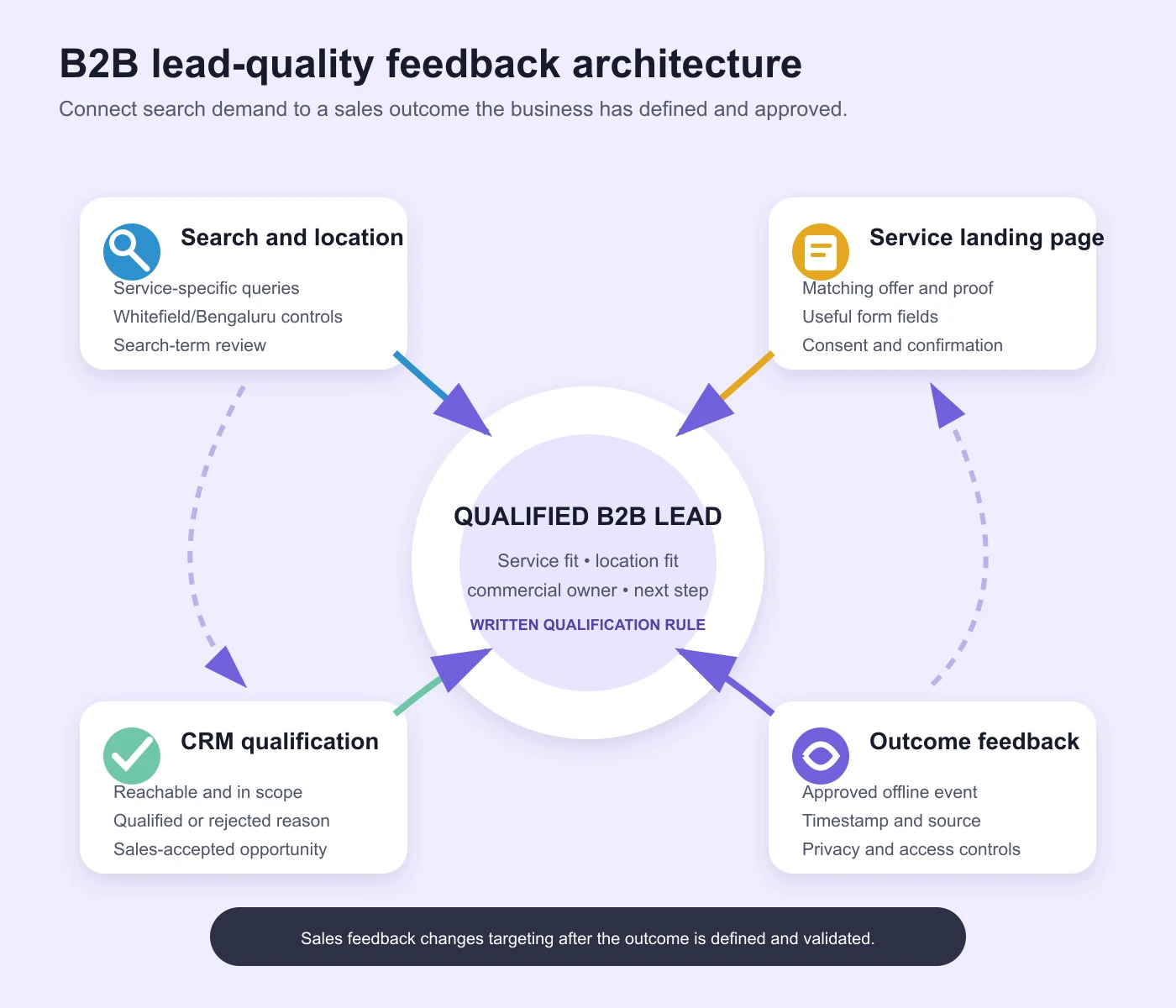
Write the lead definition before choosing a bidding strategy. Sales and marketing should agree on the services being promoted, the buyer roles, minimum project conditions, locations served, exclusions, and the outcome that counts as qualified. The definition can vary by service, so one generic form status may hide useful differences.
A software-development enquiry may need a problem statement, intended users, integration needs, timing, and a commercial owner. A managed-service enquiry may depend more on the current platform, support coverage, risk, and handover expectations. The campaign and landing page should collect only the information needed for the next decision.
WebEscalate’s city-level Google Ads agency Bangalore guide covers the broader management process. This Whitefield article concentrates on B2B qualification, local targeting choices, and feedback from sales outcomes.
Separate Campaigns by Service and Buyer Intent
Search campaigns are easier to evaluate when each one has a clear commercial job. Avoid mixing software development, website redesign, automation, ecommerce work, and general marketing into one group of ads. The searches, proof, landing-page questions, and sales owners differ.
Start with the terms a buyer might use when a project is active. Keep research queries separate from commercial searches when their landing pages and budgets need different treatment. Review the actual search terms after launch. Google’s search terms report guidance explains that the report shows searches that triggered an ad and can support keyword and negative-keyword decisions.
Negative keywords need review rather than a copied master list. Google’s negative-keyword guidance notes that negative matching behaves differently from positive keyword matching and does not automatically cover every close variation. Add exclusions for irrelevant intent, then check whether singular, plural, or related versions still appear.
Set Location Controls Around the Sales Model
Whitefield can be relevant in different ways. A company may serve only nearby customers, sell across Bengaluru, or deliver remotely to buyers in India and other markets. The account structure should reflect that operating model instead of adding a locality name to every campaign.
Google Ads allows targeting by countries, areas within a country, radiuses, and location groups. Its location-targeting documentation also warns that very small targets may show ads intermittently or fail to meet targeting criteria. Check whether Whitefield is available at the needed level, and document the fallback if a radius or larger Bengaluru target is used.
Location settings also affect who is eligible based on presence or interest. Choose the option that matches delivery. A local on-site offer and a remote B2B service may need separate campaigns, budgets, and landing pages. Review the geographic report after launch because the selected target alone does not prove where qualified buyers came from.
Use a Landing Page Built for B2B Evaluation
The landing page should continue the promise made in the search term and ad. A buyer looking for Google Ads management needs the service scope, account ownership, measurement plan, reporting process, relevant evidence, and next step. Sending the click to a general marketing page makes comparison harder.
B2B buyers may need technical, commercial, and operational information before submitting an enquiry. Put approved proof beside the service it supports. If a named case study is unavailable, explain the working method and the checks applied. Do not substitute an invented result or an anonymous percentage.
Keep forms proportional to the decision. A short first-contact form can ask for the service, company, website, and project context. A later qualification step can collect budget or technical requirements when the sales process needs them. Test validation, consent, confirmation, email delivery, CRM receipt, and mobile usability.
Track Primary Conversions Without Rewarding Noise
Set conversion actions according to business value. A confirmed enquiry or booked meeting may be primary. Page views, button clicks, scrolls, and form starts can remain secondary diagnostic events. If every interaction becomes a primary conversion, automated bidding receives a mixed signal.
Record the source fields needed to connect a lead with its campaign and landing page. Test the Google tag or analytics implementation in production-like conditions, then compare platform data with the form system and CRM. Differences can occur, so the team needs one written reporting rule.
Consent and data handling belong in the implementation plan. Enhanced conversions for leads use hashed, user-provided data to support measurement. Google’s current enhanced conversions for leads guidance directs advertisers using offline conversions toward Data Manager and explains the 2026 API changes. Its Google Tag Manager setup guide describes the related tag and user-provided-data configuration. Use the method that fits the company’s consent, privacy, security, and CRM controls.
Return Qualified Sales Outcomes to the Account
A lead form shows that someone submitted information. It does not show whether the company matched the service, a salesperson reached the contact, a discovery call happened, or an opportunity was created. Keep these stages distinct in the CRM.
Choose the offline outcomes worth returning to Google Ads. A qualified lead or sales-accepted opportunity may be more useful than every status change. Define the stage owner, qualification rule, timestamp, and correction process. Sales teams also need a consistent way to reject spam, vendors, job applicants, students, and enquiries outside scope.
Do not upload customer information until the company has confirmed its legal basis, disclosures, consent handling, access controls, and vendor terms. Hashing is part of Google’s matching process, but it does not replace the advertiser’s privacy obligations or internal approval.
Review Search Terms and Lead Quality Together
The search terms report and CRM should be reviewed in the same operating cycle. Search terms can show where the budget went. Sales outcomes show whether those searches produced the type of conversation the business wants.
A useful weekly review covers irrelevant terms, location quality, ad-to-page consistency, form failures, duplicate leads, and sudden changes in volume. A monthly review can compare spend, primary conversions, qualified leads, sales-accepted opportunities, and reasons for rejection. Avoid changing several major settings at once when the data is too thin to separate their effects.
Lead quality should be evaluated by service and campaign. One campaign may produce fewer contacts but a higher share of appropriate enquiries. Another may need a new landing page or a tighter query set. The review should result in a named action, owner, and date rather than a report with no decision.
Protect Account Ownership and Change History
The business should retain access to its Google Ads account, billing, analytics, tag manager, landing pages, and CRM integrations. Agency access can be granted through the appropriate manager relationship. The client should not lose campaign history or conversion definitions when a contract ends.
Use clear naming for campaigns, ad groups, conversions, audiences, and experiments. Record major changes in a shared log with the reason, date, owner, and expected observation period. Google Ads change history provides a platform record, while the shared log can connect the change to sales feedback and approval.
WebEscalate’s website development services can support landing-page and tracking work when the existing site cannot provide a suitable campaign path. The digital marketing agency Bangalore guide explains how paid search fits with broader channel planning.
A Practical B2B Google Ads Operating Sequence
- Agree the commercial scope: document the promoted services, buyer roles, locations served, exclusions, sales owners, and qualification rules.
- Audit the account and website: review access, history, current search terms, conversion actions, landing pages, analytics, and CRM fields.
- Build the campaign structure: separate distinct services and intent, write relevant ads, prepare negatives, and choose location settings.
- Validate measurement: test consent, tags, forms, confirmation, source capture, CRM delivery, and approved offline outcomes.
- Launch with controls: confirm budgets, bidding, schedules, devices, locations, ads, pages, and alert ownership.
- Review and improve: connect search terms with lead outcomes, document decisions, and allow enough time to read the effect.
The exact sequence can change with the account’s history and data volume. Every phase should still have an owner and an acceptance check. A campaign is not ready because the ads are approved if the form, tracking, or CRM handoff remains untested.
How to Compare Google Ads Agencies for Whitefield B2B Campaigns
Ask each provider to show how it will define and measure qualified leads. Useful questions include:
- Which services, buyer roles, and exclusion rules will shape the campaigns?
- How will Whitefield, Bengaluru, and remote markets be separated?
- Which search terms and negative keywords will be reviewed, and how often?
- Who owns landing-page changes, form testing, analytics, and CRM integration?
- Which conversion actions are primary, secondary, and imported from sales?
- How will privacy, consent, customer data, and access be handled?
- What work is included in the fee, and which costs remain separate?
A proposal should separate media spend, setup, ongoing management, landing-page work, tracking, creative production, and third-party tools. It should also state the reporting period and what happens when lead feedback is missing.
Frequently Asked Questions
How much should a B2B company spend on Google Ads?
The budget depends on the service, target market, auction, campaign structure, sales capacity, and acceptable acquisition economics. Start with a documented test that can collect enough evidence for a decision. This article does not state a Whitefield benchmark because no verified account data was supplied.
Can Google Ads generate qualified B2B leads?
Google Ads can reach people who are actively searching, but the platform cannot define lead quality for the business. Campaign structure, landing pages, forms, qualification rules, CRM stages, and sales feedback determine whether the account learns from appropriate outcomes.
Should Whitefield be a separate campaign?
Use a separate campaign when the location has a different offer, budget, service area, page, schedule, or sales owner. If the same service and process apply across Bengaluru, a broader campaign with location reporting may be easier to manage. Confirm which targeting options Google Ads supports at the required geographic level.
Is a Google Ads agency worth it for B2B services?
An agency may help when the business needs campaign structure, tracking, landing-page work, regular search-term review, and CRM feedback. Value depends on the account, service margins, data quality, sales follow-up, media spend, and management fee. Ask for clear deliverables and ownership.
How long does Google Ads take to produce results?
Ads can begin serving after approval, but qualified-lead evidence takes longer when search volume is low or the sales cycle is long. The plan should separate launch checks, early search-term review, conversion validation, lead qualification, and opportunity reporting. Avoid a fixed promise without account data.
Plan Paid Search Around Qualified Outcomes
A Google Ads agency in Whitefield Bangalore should be evaluated on the controls that connect spend with appropriate sales conversations: service-specific campaigns, deliberate location settings, relevant landing pages, reliable conversion actions, and an approved CRM feedback path.
To review an account, share the promoted services, locations served, current campaign access, landing pages, conversion definitions, CRM stages, and recent lead-quality issues through the WebEscalate contact page. The first task is to agree on what the campaign should count and what sales will return.