Digital marketing agency in BTM Layout Bangalore support should begin with one practical question: which enquiries are useful to the business? A form submission, call, WhatsApp message, booking, store visit, and quote request can all look like leads, but they do not carry the same intent or value. Local campaigns work better when the team defines the service, customer, coverage area, and next sales action before it chooses channels.
This guide is for service businesses that genuinely serve customers in BTM Layout and nearby parts of Bengaluru. It covers local search, paid search, landing pages, lead qualification, and measurement without claiming that WebEscalate has an office in BTM Layout. It also avoids guaranteed rankings, lead volumes, and return figures because those outcomes depend on the offer, competition, budget, website, follow-up, and available evidence.
What a digital marketing agency in BTM Layout Bangalore should define first
A campaign brief needs more than a location and a list of services. Name the service that should generate demand, the customer who can buy it, the locations the business can actually serve, the action that counts as an enquiry, and the conditions that make an enquiry qualified. A clinic may care about appointment eligibility and preferred time. A home-service company may need the exact postcode, property type, and urgency. A professional firm may need the problem, budget range, and decision window.
Write those rules down before creating ads or pages. They influence keyword selection, form fields, calls to action, response routing, and reporting. They also prevent a common measurement error: celebrating a larger submission count when the sales team is receiving more spam, job applications, vendors, or enquiries outside the service area.
The first plan should also separate brand demand from new-customer demand. People who already know the business behave differently from buyers comparing several providers. Reporting both groups as one audience can make a campaign look stronger than it is.
Use truthful service coverage for BTM Layout searches
A business can create a page for BTM Layout when the service coverage is real and the page gives local buyers information they cannot get from a generic city page. That does not justify an invented branch, address, local team, client, or travel time. The page should explain which service is available, who it suits, how delivery or meetings work, and what happens after an enquiry.
Google’s service-area guidance says a service-area business should use the areas it genuinely serves and remove its address when it does not receive customers there. Google also limits a service-area business to one profile for the area it serves. Creating extra profiles or location claims simply to cover more neighbourhoods can mislead customers and put the profile at risk.
Use the broader digital marketing agency in Bangalore page for city-wide service information. Let this BTM Layout page handle local lead generation decisions, service coverage, enquiry paths, and sales feedback. That separation gives each page a distinct job and reduces the chance of near-duplicate locality pages.
Choose channels from buyer behaviour, not a fixed package
Channel selection should follow how the intended customer looks for help. A buyer searching for a service and a location may be ready to compare providers, so paid search, local SEO, and a focused landing page can be relevant. A buyer who needs education before making contact may respond better to a useful guide, comparison page, email sequence, or remarketing audience. A local walk-in or visit-based service also needs accurate profile information, calls, directions, and opening details.
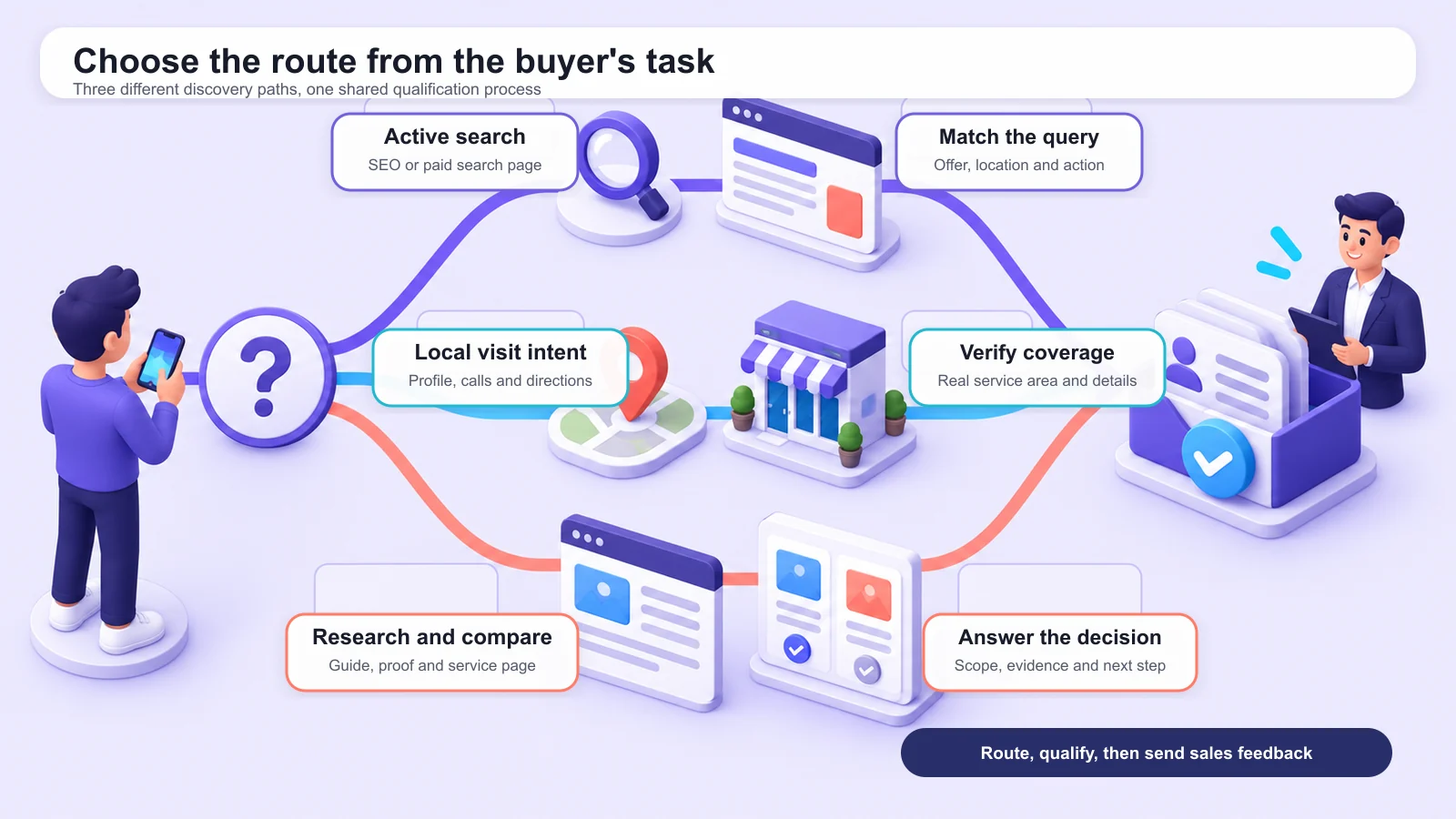
The visual is a planning aid, not a promise that one channel will always win. Search demand, competition, creative quality, offer clarity, budget, and follow-up can change the result. Start with the smallest channel mix that can answer the buying task and produce enough evidence to make the next decision.
Build one focused landing path for each lead intent
A local campaign should send visitors to a page that matches the service and reason for the click. The page needs a clear offer, scope, suitable customer, service coverage, evidence, process, common objections, and contact route. Sending every search to a broad homepage forces buyers to work out whether the business handles their problem.
Keep the page specific without repeating the location unnaturally. The primary heading, title, introduction, service details, and contact context can establish relevance. The rest of the page should answer real buying questions. A useful BTM Layout page will discuss how enquiries are handled for that service, not fill several paragraphs with nearby place names.
The form should ask only for information the team can use. Longer forms may reduce completion, while very short forms can produce weak qualification. Test the trade-off against actual sales feedback. Make phone, email, booking, and WhatsApp routes easy to use on mobile, and confirm that each route reaches the correct owner.
Control paid search around qualified enquiries
Paid search can reach buyers who already express a need, but the campaign needs controls. Review search terms, match types, negative keywords, locations, schedules, devices, ad messages, and landing-page alignment. Google’s search terms guidance explains that the report shows the searches that triggered ads and can help refine keywords and exclusions.
Do not treat every click or form as success. Google Ads supports separate conversion actions for website forms, calls, app activity, and offline outcomes. Its conversion measurement guidance recommends choosing the actions that matter to the business and configuring them as separate conversions where useful.
Sales outcomes matter when the purchase happens after a call or consultation. A campaign can record the initial enquiry and later return qualification or customer status where the business has the systems and consent to do so. This helps the team see which searches produce suitable conversations instead of optimizing only for the cheapest submission.
Use local SEO without creating a false local presence
Local SEO work should begin with an accurate Business Profile, consistent business details, a useful service page, customer reviews gathered through compliant requests, and a website that makes the service area clear. Google’s business representation guidelines require a business to reflect its real-world identity and location.
A remote agency serving BTM Layout should say that it serves the area. It should not display a coworking address, virtual office, borrowed address, or fabricated branch as proof of local presence. The website and profile should match how customers can actually meet, visit, or receive the service.
The local SEO services in Bangalore page covers profile accuracy, listings, reviews, technical checks, and measurement in more detail. This page keeps the focus on how local discovery contributes to a qualified lead plan.
Measure leads from first response to sales outcome
Record the initial source, campaign, service, location, contact route, and timestamp when the systems allow it. Then add a small set of sales statuses that the team will use consistently. Useful examples include new, contacted, qualified, not qualified, proposal sent, and customer. Keep the definitions simple enough for staff to apply after every conversation.
Google Analytics recommends lead-generation events such as generate_lead, qualify_lead, disqualify_lead, and close_convert_lead for online and offline lead funnels. Its recommended events documentation explains when those events apply. The event names alone do not improve reporting; the website, CRM, and sales process need to send accurate status changes.
Use a verified lead action as the main website key event. Google’s explanation of key events and conversions distinguishes an important analytics event from a conversion used for advertising measurement. A scroll or button click can help diagnose behaviour, but it should not replace a submitted and received enquiry.
Plan reporting around decisions the business can make
A monthly report should connect spend and activity to qualified outcomes. Include the source and landing page, calls or forms, qualification rate, reasons for rejection, response time, and sales result where the data is available. Avoid combining unverified estimates with CRM results in one total.
Use the report to decide what changes next. A high click-through rate with weak enquiries may point to broad targeting or an offer mismatch. Strong enquiries with slow follow-up may require a routing or staffing fix rather than more traffic. A page with useful visits but few actions may need clearer scope, evidence, or contact options.
Document tracking gaps. Call outcomes, WhatsApp conversations, walk-ins, and repeat customers may not enter the same system automatically. State what the report includes, what it excludes, and which team owns each missing step.
How to assess a digital marketing agency in BTM Layout Bangalore
Ask the agency to explain how it separates local search intent from broad Bangalore demand, how it verifies service coverage, and how it prevents one locality page from copying another. Review the proposed keywords, landing paths, conversion actions, lead definitions, reporting fields, and approval process before work begins.
The proposal should name the accounts and assets the client will own. That includes advertising accounts, analytics properties, Business Profile access, website content, creative files, audience lists, and reporting exports. It should also explain who approves claims, budgets, location changes, and campaign launches.
Be cautious with guaranteed rankings, fixed lead volumes, or return claims offered before the agency has reviewed the offer, competition, website, tracking, and sales process. Ask for evidence behind any case study and confirm that the example is comparable to the service being proposed.
Frequently asked questions
Does a business need an office in BTM Layout to market there?
No office claim is needed when the business genuinely serves customers in BTM Layout. The website should describe the real coverage and delivery model. A Business Profile must follow Google’s eligibility and address rules, so a remote service provider should not invent or borrow a local address.
Which digital marketing channel is best for local leads?
The answer depends on buyer behaviour. Search and local discovery can suit people already looking for a provider. Content, social media, or email may help when buyers need education or repeated contact. Start with the buying task and test qualified outcomes rather than choosing a channel from a standard package.
How should local lead quality be measured?
Define a qualified lead using service fit, location, need, timing, and any other information the sales team genuinely uses. Record the first enquiry and update the result after contact. Separate spam, jobs, vendors, duplicates, and requests outside the service area.
How long does local digital marketing take to work?
Paid campaigns can begin collecting data after launch, while organic visibility usually needs more time for content, profile work, links, reviews, crawling, and competition. A reliable timeline depends on the starting point and scope. Use agreed review dates instead of a guaranteed ranking date.
What should be included in a local marketing report?
Include campaign activity, landing pages, calls or forms, qualified leads, rejection reasons, sales outcomes, and known tracking gaps. Report the definition and source of each number so the business can compare periods without mixing different measures.
Build the BTM Layout plan around qualified local demand
A digital marketing agency in BTM Layout Bangalore should connect local demand to a service page, a verified enquiry, and a clear sales outcome. Accurate service coverage, focused landing paths, controlled paid search, compliant local SEO, and qualification feedback give the campaign a basis for improvement.
Businesses that serve BTM Layout can review WebEscalate’s broader paid search marketing and Bangalore marketing services, then contact WebEscalate to discuss the service, customer, coverage area, and current tracking. Any proposal should follow a review of the actual website, accounts, and sales process.