
Website redesign services in Jayanagar Bangalore should begin with a diagnosis, not a new colour palette. An established business may already have pages that rank, forms that reach the sales team, returning visitors who know the navigation, and campaign links that depend on the current URLs. A redesign can improve the site, but careless changes can also break those working parts.
This guide is for local service firms, clinics, retailers, professional practices, education providers, and other established businesses serving Jayanagar and the wider Bengaluru market. It explains how to plan a redesign around buyer tasks, search visibility, measurement, and a controlled launch. WebEscalate does not claim a Jayanagar office or a local client result that has not been supplied.
What website redesign services in Jayanagar Bangalore should solve
A redesign needs a business reason. “The website looks old” is too broad to guide page structure, content, or technical work. The first review should identify where the current site blocks a useful action: a visitor cannot understand the service, compare options, trust the evidence, complete a form, use the site on a phone, or reach the correct team.
That review separates design problems from traffic, offer, and tracking problems. A site with very little relevant traffic may need stronger search and campaign work as well as a new interface. A site with steady visits but weak enquiries may need clearer service pages, proof, calls to action, or form routing. If enquiries arrive but the sales team cannot qualify them, changing the homepage alone will not fix the handoff.
Agree on a short set of outcomes before wireframes begin. These can include making one service easier to find, reducing form errors, preserving organic landing pages, improving mobile navigation, or recording qualified enquiries consistently. The outcome should be measurable with current data or a baseline captured before launch.
Audit the current website before designing a replacement
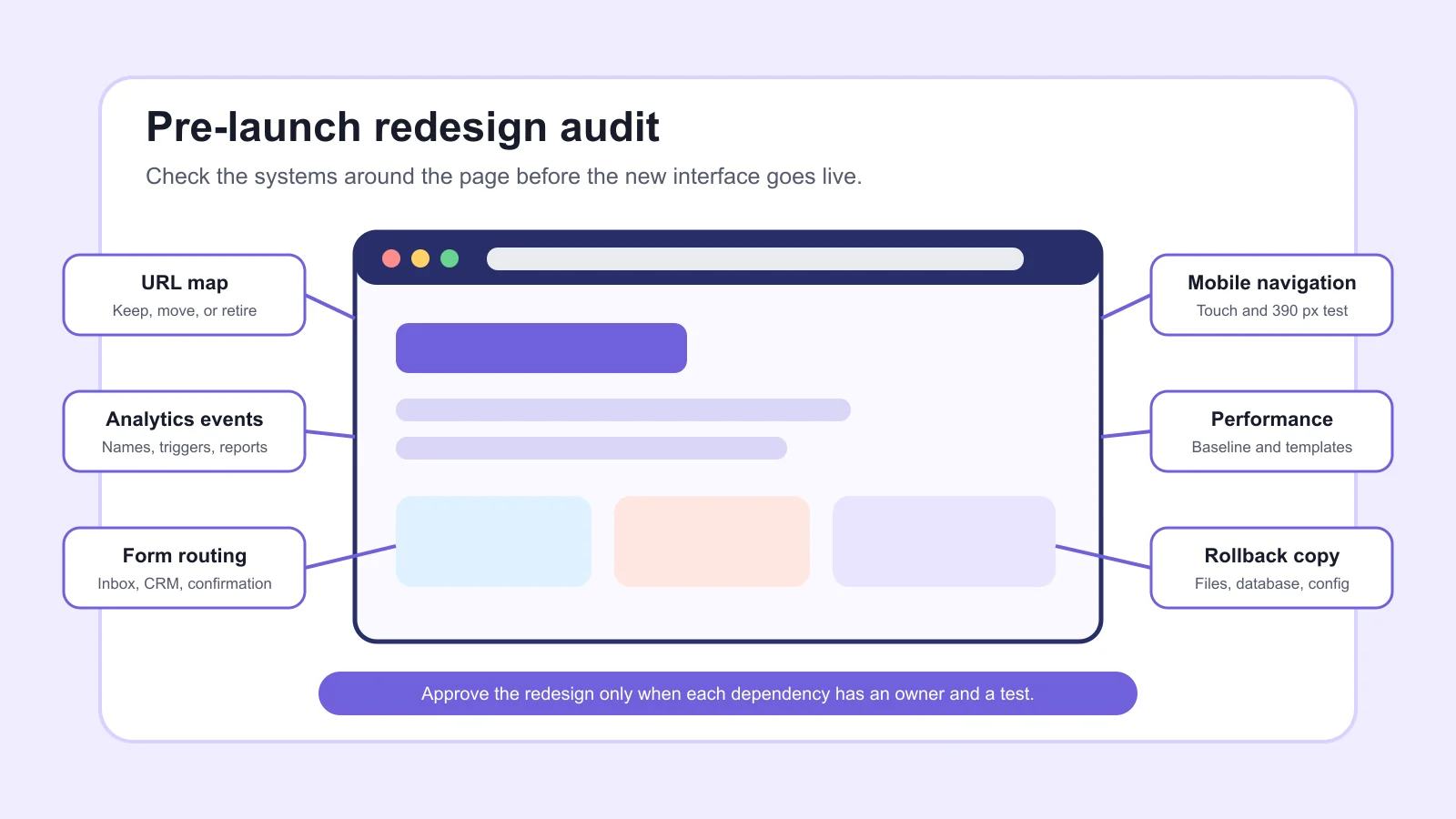
Start with an inventory of the existing site. List every indexable URL, page title, main purpose, traffic level, backlink value, form, downloadable file, tracking event, integration, and page owner. Mark the pages that already attract search impressions or qualified enquiries. Those pages need an explicit decision: preserve, improve, consolidate, or retire.
The audit should also follow the buyer’s route through the website. For a service business, test whether a new visitor can identify the right service, understand its scope, see relevant evidence, and contact the team without searching through several unrelated pages. For a clinic or appointment business, test the service details, eligibility information, booking route, and confirmation step. Use actual tasks rather than asking whether people “like” the design.
Record technical dependencies at the same time. Contact forms may send messages to email, a CRM, a spreadsheet, or an automation platform. Phone and WhatsApp buttons may contain campaign parameters. Consent tools can affect when analytics loads. A redesign brief that ignores these connections is incomplete.
Preserve URLs and search signals during the redesign
A visual redesign does not always require new URLs. Keeping a useful page at the same address reduces migration work and keeps existing links intact. When a URL must change, map the old address to the closest relevant new page and use a server-side permanent redirect. Google’s redirect guidance recommends permanent redirects for lasting moves and advises against sending many unrelated old pages to one destination.
The migration list should include current URLs, proposed URLs, redirect targets, canonical tags, index rules, internal links, sitemap entries, and campaign links. Test every redirect before launch and again after deployment. Avoid redirect chains when one direct route can reach the final page. Keep a record of pages that intentionally return a 404 so the team can distinguish a planned removal from a broken migration.
Search visibility can fluctuate after major URL changes while Google recrawls and processes the move. No agency can promise that every position will remain fixed. Google’s site-move documentation recommends accurate URL mapping, redirect testing, updated links and sitemaps, and post-launch monitoring.
Protect forms, analytics, CRM routes, and campaign data
Forms and tracking need their own acceptance tests. Submit each form with a test record and confirm that the message reaches the intended inbox or system, the thank-you state appears, spam controls work, and the correct source information is stored. Test phone, email, booking, map, and WhatsApp links on both desktop and mobile.
Google Analytics records important business actions as key events. Before the redesign, list the events that matter and capture their current names, triggers, parameters, and reports. After launch, confirm that the redesigned pages still send those events once per intended action. A page view is not a substitute for a verified enquiry or booking event.
Campaign teams should also preserve landing-page URLs or update ads, emails, QR codes, and partner links before traffic reaches the new site. If a form now sends data to a different CRM field or pipeline, document the change and verify that sales staff can still see the source, service, and location requested.
Build clearer lead paths for established local businesses
An established Jayanagar business may offer several services to different customer groups. The redesigned navigation should reflect how those buyers choose, not the company’s internal department chart. Give each important service a focused page with its scope, suitable customer, process, evidence, common questions, and contact route.
The homepage can introduce the business and route visitors, but it should not carry every detail. Link to the relevant service pages, a useful about or proof page, and the contact option. Place the main call to action after visitors have enough information to judge whether the service fits. Repeat it where a long page creates another natural decision point.
Local context must stay accurate. The page can state that a business serves Jayanagar when that coverage is real, but it should not invent a branch, address, local team, client, or travel time. A redesign project can connect locality pages to a broader Bangalore local SEO structure without creating dozens of near-identical pages.
Improve mobile use, performance, and accessibility
Review the redesigned site at small screen widths before approval. Navigation, forms, tables, sticky buttons, cookie notices, and embedded maps can behave differently on a phone. Test with a 390-pixel viewport and real touch interactions. Keep phone numbers selectable, form labels visible, and error messages close to the field that needs attention.
Performance work should use measured evidence. Google’s Core Web Vitals cover loading performance, responsiveness, and visual stability. Capture the current field or lab baseline where available, then test representative templates after development. Compress images, avoid shipping unused scripts, reserve space for media, and verify that the final production site performs like the approved build.
Accessibility belongs in the design and QA process. Use semantic headings, keyboard access, visible focus states, sufficient colour contrast, descriptive labels, useful alternative text, and clear error recovery. The W3C’s WCAG 2.2 standard provides a shared framework for checking these behaviours. Automated tools help find some issues, but keyboard and task-based testing still matter.
Use staging, backups, and a rollback plan
Build and test the redesign in a staging environment that is not indexed as a competing public site. Restrict access where practical and make sure temporary noindex or crawl blocks do not remain on the production version after launch. Take a verified backup before deployment and record how to restore it.
A launch checklist should name the owner of each check. Cover URLs, redirects, forms, analytics, consent, CRM routes, navigation, search, schema, sitemap, robots rules, page titles, meta descriptions, images, and cache behaviour. Test a sample from every page template rather than only the homepage.
Define the rollback trigger before launch. A broken payment or enquiry path, widespread server errors, missing critical pages, or lost tracking may require a rollback while the team investigates. The decision is easier when the previous version, database, media, and configuration are recoverable.
Measure the redesign after launch
A redesign needs a review period after release. Watch server errors, Search Console coverage, organic landing pages, Core Web Vitals, form completions, calls, bookings, and qualified enquiries. Compare like periods and note campaign, seasonal, or offer changes that could affect the result.
Do not label every submission as a lead. Separate spam, job applications, vendors, duplicate messages, and enquiries outside the service area. Sales feedback helps the marketing team see whether the new site attracts suitable prospects and whether the page promised the same service the sales team delivers.
WebEscalate has not been given a verified Jayanagar redesign case study for this page, so no before-and-after percentage is presented. A future case study should document the starting point, exact changes, time period, measurement method, and limits of the evidence.
How to assess a website redesign company in Jayanagar
Ask the provider to explain the audit, page map, content responsibilities, design review, development environment, migration plan, QA method, launch steps, and post-launch support. The proposal should state what is included and what depends on another vendor, account, or system.
Request examples that match the type of work, but verify that the provider had permission to show them. A screenshot alone does not prove the team handled analytics, migration, accessibility, or lead routing. Ask what changed, how it was tested, and which result the available data supports.
Be cautious with guaranteed ranking or conversion claims, a redesign plan that ignores existing URLs, or a fixed timeline offered before the current site has been reviewed. A suitable provider should be willing to preserve what works and explain when a smaller set of fixes would be more sensible than a full rebuild.
Frequently asked questions
How do I know whether my business website needs a redesign?
Review buyer tasks and current evidence first. A redesign may be appropriate when the structure, platform, mobile interface, accessibility, or content model blocks important improvements. Smaller fixes may be enough when the problem is limited to a form, one service page, tracking, or a few performance issues.
Will a website redesign affect SEO?
It can. Changing URLs, content, internal links, canonical tags, index rules, or site performance can change how search engines crawl and understand the site. Keep useful URLs where possible, map necessary changes, use relevant permanent redirects, update internal links and sitemaps, and monitor Search Console after launch.
How much does a website redesign cost in Jayanagar?
Cost depends on the number of templates, content work, platform, integrations, migration risk, accessibility requirements, and testing scope. A responsible estimate follows an audit and written scope. This page does not publish an invented local price range.
How long should a website redesign take?
There is no reliable fixed timeline without reviewing the site and approval process. Content availability, stakeholder feedback, integrations, migration work, and QA can change the schedule. Ask for milestones, dependencies, review windows, and a launch-readiness gate.
Should the existing content be rewritten during a redesign?
Review it page by page. Keep accurate content that serves the intended query or buyer task. Improve weak or outdated sections, consolidate true duplicates, and remove pages only with a documented reason and redirect decision. Do not replace useful pages merely to make every line sound new.
Plan the redesign around evidence and a safe launch
Website redesign services in Jayanagar Bangalore are most useful when the project protects working search, measurement, and enquiry systems while improving the buyer experience. The audit defines the problem, the page map defines ownership, and the launch plan controls risk.
Businesses serving Jayanagar can review the broader website redesign services in Bangalore or contact WebEscalate for an initial assessment. The first step should confirm the current URLs, lead path, tracking, integrations, and evidence before a scope or result is promised.